

Instruct One Another

Summary of my sermon, based on Romans 15:14-16. Preached at Greenhills Christian Fellowship Toronto on September 7, 2025.

It’s been a little over five hundred years since Martin Luther posted his Ninety-five Theses and sparked the Protestant Reformation. We often summarize that movement with the five solas, but there’s a pastoral thread that can be overlooked: the question of language in worship and in our Bibles. For centuries much of Western Christianity heard Scripture read publicly in Latin—even when few understood it. The Reformers pressed forward the conviction of Scripture alone: if the Bible is our final authority for faith and practice, then God’s people must be able to hear and read it in their own tongue. That conviction helps explain why Luther translated the Bible into German and why, over time, churches moved toward the language of the people.

That ties directly to our text: “I myself am satisfied about you, my brothers, that you yourselves are full of goodness, filled with all knowledge and able to instruct one another” (Romans 15:14, ESV). Paul is not only speaking to pastors; he is addressing the church. Because the gospel has taken root, ordinary believers—indwelt by the Spirit—are able to teach and admonish one another. He adds that he writes “very boldly by way of reminder, because of the grace given me by God to be a minister of Christ Jesus to the Gentiles… so that the offering of the Gentiles may be acceptable, sanctified by the Holy Spirit” (Romans 15:15–16, ESV). Paul’s ministry is by grace, and our mutual ministry is too.

Yesterday I sat in on an Evangelism Explosion preview. One of the guests, Richard, professed faith in Christ—praise God. In another group a man named Greg voiced a familiar objection: a pastor stands at a podium and tells people what to believe. I would answer this way: Christian preaching isn’t someone imposing opinions; it is the Spirit opening the text he inspired. As Paul says, “And we impart this in words not taught by human wisdom but taught by the Spirit, interpreting spiritual truths to those who are spiritual” (1 Corinthians 2:13, ESV). And the sermon is only one hour a week. There are 167 other hours where the command of Romans 15:14 lives—around dinner tables, in small groups, over coffee, on phone calls—where believers gently, humbly bring God’s Word to one another.
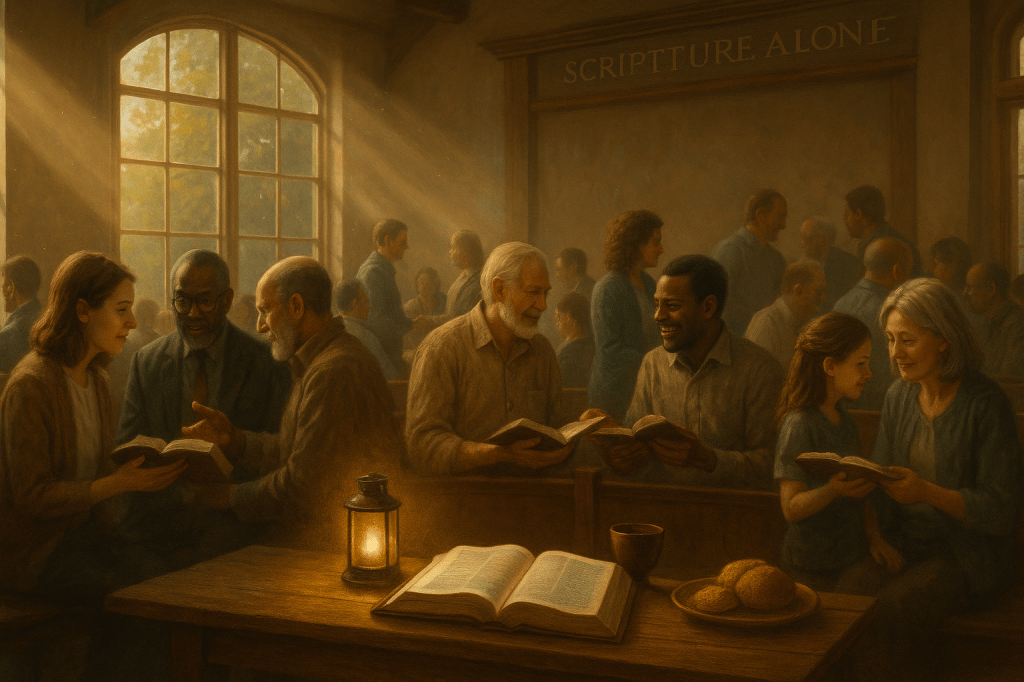
Jesus promised this help for all his disciples: “But the Helper, the Holy Spirit, whom the Father will send in my name, he will teach you all things and bring to your remembrance all that I have said to you” (John 14:26, ESV). If you belong to Christ, the Spirit is your Teacher. You are not left to yourself, and you are not disqualified from speaking God’s truth in love.

With that privilege comes a boundary. We do not teach our hunches or preferences; we teach what God has said. “Trust in the Lord with all your heart, and do not lean on your own understanding. In all your ways acknowledge him, and he will make straight your paths. Be not wise in your own eyes; fear the Lord, and turn away from evil. It will be healing to your flesh and refreshment to your bones” (Proverbs 3:5–8, ESV). Peter presses the same point: “And we have the prophetic word more fully confirmed, to which you will do well to pay attention as to a lamp shining in a dark place… knowing this first of all, that no prophecy of Scripture comes from someone’s own interpretation. For no prophecy was ever produced by the will of man, but men spoke from God as they were carried along by the Holy Spirit” (2 Peter 1:19–21, ESV). The Spirit who inspired the Word never contradicts the Word.

And here is the purpose: we teach one another so that our lives might be an acceptable offering to God, sanctified by the Holy Spirit (Romans 15:16). Mutual instruction is priestly service. It keeps pointing us back to the gospel—Christ crucified, buried, and risen; repentance and faith; walking by the Spirit. If you want to grow in this calling, begin here: know the gospel and know your Bible. Read it daily. Read it with someone. Memorize a verse you can share this week. Ask, “How does this passage lead me to Christ?” Then look for one concrete opportunity to encourage, correct, or comfort a brother or sister with the Word.

As we come to the Lord’s Table, we remember that “as often as you eat this bread and drink the cup, you proclaim the Lord’s death until he comes” (1 Corinthians 11:26, ESV). Church, you are full of goodness, filled with knowledge, and—by the Spirit—able to instruct one another. Let’s walk in that grace together.

Welcome One Another

Summary of my sermon, based on Romans 15:7-13. Preached at Greenhills Christian Fellowship Toronto on August 3, 2025.

When I arrived at Capernwray, I felt like a fish out of water. Most of the students were from small towns in rural Alberta—white, small-town kids who’d never lived in a city. I was one of only three Asians and definitely the only one from a big city. They nicknamed me “Big City Brown Bear.” Everything about me—from my clothes to my taste in music—set me apart. And yet, despite the differences, I felt completely welcome. Why? Because we all had one thing in common: our faith in Jesus Christ. And when Christ is the center, most differences fade into the background.

That’s how it should be in the church. But the truth is, we often argue about small things—things that shouldn’t divide us. That’s why Paul says in Romans 15:7, “Therefore welcome one another as Christ has welcomed you, for the glory of God.” If it were easy to get along, Paul wouldn’t have had to say this. So what was going on?

To understand, we have to look back to Romans 14. There Paul writes, “As for the one who is weak in faith, welcome him, but not to quarrel over opinions” (v.1). That phrase “welcome him” is the same verb Paul uses in 15:7. The issue in Rome wasn’t false teaching—it was disagreement over things like food. Some believers felt free to eat anything. Others, whom Paul refers to as “weak in faith,” ate only vegetables.

Why the restriction? Some think they were avoiding meat sacrificed to idols, like the situation Paul addressed in 1 Corinthians 8. But in Rome, the issue likely had more to do with Jewish Christians trying to keep kosher. Because they had been cut off from the Jewish community for following Christ, they couldn’t get kosher meat—and so they stuck with vegetables. These believers were already being marginalized by their own people. And now, some Gentile Christians were judging or even despising them for their dietary convictions.

Paul is clear: this should not be. “Who are you to pass judgment on the servant of another?” (Romans 14:4). He reminds both groups that “the kingdom of God is not a matter of eating and drinking but of righteousness and peace and joy in the Holy Spirit” (v.17). In other words, don’t let food or tradition cause division. Focus on what truly matters—life in the Spirit.

What’s remarkable is how gracious Paul is here. In his letter to the Galatians, he’s angry because some were insisting that Gentiles follow the Jewish law to be saved. That, Paul says, is a false gospel. But in Romans, the Jewish Christians weren’t trying to impose their views—they were simply trying to live according to their convictions. And the Gentiles were misjudging them. So Paul urges both groups to stop judging and start welcoming.

Romans 15:7 drives the point home: “Welcome one another as Christ has welcomed you.” Christ didn’t wait until we had perfect theology or the right lifestyle. He welcomed us in grace. And that’s how we’re to welcome others—especially when they see things differently. Paul continues, explaining that Jesus came as the Jewish Messiah to confirm God’s promises, “in order that the Gentiles might glorify God for his mercy” (v.9). Then he quotes four Old Testament passages—one each from the Law, the Prophets, and the Writings—showing that Gentiles were always meant to join the Jews in worshiping God.

So what does this mean for us? It’s easy to divide over minor issues—especially convictions that aren’t essential to the Gospel. Protestants have split into countless denominations, often over secondary matters. Even within churches, we can be tempted to look down on each other for our choices—what we listen to, watch, or how we raise our kids. But we’re called to something better.

We need discernment. Paul isn’t saying ignore sin—there’s still a place for lovingly confronting what’s wrong. But he is saying don’t turn personal convictions into dividing lines. Instead, pursue what leads to peace and mutual upbuilding.

That’s why Paul ends with this prayer: “May the God of hope fill you with all joy and peace in believing, so that by the power of the Holy Spirit you may abound in hope” (Romans 15:13). Joy, peace, and hope—those are the marks of a church that truly welcomes like Christ.

Outdo One Another in Showing Honour

Summary of my sermon, based on Romans 12:9-13. Preached at Greenhills Christian Fellowship Toronto on March 2, 2025.

The world has its own way of defining honor—bravery in battle, sacrifices made for others, accomplishments that inspire awe. Just think of Telesforo Trinidad. Most of us had never heard his name, but the US Navy did something extraordinary in his memory. They decided to name a warship after him—one of their most powerful destroyers. Why? Because in 1915, after surviving a deadly boiler explosion aboard the USS San Diego, he ran back—twice—into the fire and smoke to rescue two fellow sailors. And he did this not in the heat of combat but during peacetime. That’s the kind of gallantry that earned him the Medal of Honor, an award given only to those who go above and beyond the call of duty. His story reminds us that true honor often looks like self-sacrifice and courage, even when no one is watching.

That’s the kind of example that easily earns respect. When someone risks their life or achieves something extraordinary, we naturally want to honor them. But in the Kingdom of God, things work differently. As followers of Christ, we’re not just called to recognize those moments of greatness—we’re called to outdo one another in showing honor. That’s not just about giving credit where it’s due. It’s about a radical kind of love that seeks to lift others up whether or not the world thinks they deserve it. Romans 12:10 tells us, “Love one another with brotherly affection. Outdo one another in showing honor.” It’s not a suggestion; it’s a command. It’s how we love genuinely, with the kind of affection that sees each other as family.

Paul doesn’t just say, “Love one another”—he says to do it with brotherly affection. That’s the love you have for your family. You don’t love your kids because they always behave. You love them because they’re yours. In Christ, we’ve been adopted into the same spiritual family. Ephesians 2:19 says we’re no longer strangers but members of the household of God. That means our love for one another should be deep, genuine, and rooted in shared identity. And if we love like that, then honoring each other becomes an extension of that love. It’s not something we tack on—it’s how love expresses itself.

And then there’s that fascinating word: outdo. Paul could’ve said “honor one another,” and left it at that. But he ups the ante. He says we should try to outdo each other in this. In other words, if someone honors you, you try to go even further in honoring them back—not to boast, but because Christ has loved you so deeply that you can’t help but overflow it onto others. It’s not a competition of pride, but a pursuit of humility. It flips the world’s values upside down. Where the world wants to be better than, Scripture calls us to be better at lifting others up.

Of course, it’s easy to show honor to someone who seems worthy of it. Think of the benefits Medal of Honor recipients receive: higher pensions, free education for their kids, even a tradition where they’re saluted by generals. But the real challenge is this: how do we honor someone who doesn’t seem worthy? What if someone hasn’t done anything particularly impressive? Or worse—what if they’ve hurt you or disappointed you?

That’s where Philippians 4:8 comes in. Paul says to focus on whatever is true, honorable, just, pure, lovely, commendable, excellent, and praiseworthy. That means we look for the good in others—even when it’s hard to find. And when someone truly is in the wrong, honoring them might mean lovingly confronting them. James 5:19–20 tells us that turning someone back from sin is a way to save them and cover a multitude of sins. In that moment, your honor isn’t about flattery or praise. It’s about loving them enough to help them return to truth.

Peter doesn’t leave room for exceptions either. “Honor everyone,” he writes in 1 Peter 2:17. Everyone. Not just the people you like. Not just Christians. Not just the ones who seem honorable. And yes, that includes even the emperor—most likely Nero at the time—a man known for his cruelty. That’s how upside down God’s Kingdom is. We show love and respect because God made people in His image, not because they’ve earned it.

Now let’s be honest. That kind of love isn’t natural. When we’re hurt, we want to withhold honor. But the gospel reminds us that we didn’t deserve honor either. We infinitely dishonored God. And yet, Romans 5:8 says that “while we were still sinners, Christ died for us.” He honored us in the most profound way—by laying down His life. If God can show us that kind of mercy, surely we can extend a measure of it to others.

To love like this, to honor like this, requires grace. It means letting go of our pride. It means dying to self. But when we do it, we don’t just reflect kindness—we reflect Jesus. We become ambassadors for Christ, showing the world a different way to live. So let’s outdo one another—not in achievement, not in accolades, but in showing honor.

Renewal & Discernment

Summary of my sermon, based on Romans 12:2. Preached at Greenhills Christian Fellowship Toronto (Family Camp) on July 7, 2024.

This morning, our focus is on Romans 12:2, a verse that challenges us with a powerful command: “Do not be conformed to this world, but be transformed by the renewal of your mind, that by testing you may discern what is the will of God, what is good and acceptable and perfect” (Romans 12:2, ESV). The theme of “Renewal” is not just for today but for the entire year at GCF Toronto. Yesterday, Pastor Ed spoke on the transformation of our minds and how this leads to a distinct Christian community. He emphasized the importance of the Fruit of the Spirit—love, joy, peace, patience, kindness, goodness, faithfulness, gentleness, and self-control—as markers of this distinction.

Today, I want to back up a little and focus on the beginning of verse 2: “Do not be conformed to this world.” This phrase directs us to what we, as believers, should be distinct from. But what does it mean to “not be conformed to this world”?

To answer this, let’s consider the concept of the “Zeitgeist,” a term rooted in 18th-century German philosophy. The word “Zeitgeist” is defined as “the defining spirit or mood of a particular period of history as shown by the ideas and beliefs of the time.” It is the prevailing attitude that shapes how most people in society think, act, and believe at a given moment.

Now, if the Zeitgeist is what motivates the world, it is precisely what should not motivate us as followers of Christ. The Apostle John warns us in 1 John 2:15-17: “Do not love the world or the things in the world. If anyone loves the world, the love of the Father is not in him. For all that is in the world—the desires of the flesh and the desires of the eyes and pride of life—is not from the Father but is from the world. And the world is passing away along with its desires, but whoever does the will of God abides forever.”

This passage serves as a biblical definition of the Zeitgeist—the desires of the flesh, the desires of the eyes, and the pride of life. These worldly motivations stand in stark contrast to what comes from the Father and are fleeting, destined to pass away with this world.

So, what is the Zeitgeist of our time? What is it that we should not love? The answer may surprise you—it’s individualism. While you might have expected me to point to hot-button issues like abortion, medical aid in dying, or gender and sexuality, the truth is that these issues are manifestations of a deeper, underlying sin: individualism.

Individualism is self-idolatry, the love of self above all else. It is the driving force behind many of the societal issues we face today. For example, the argument for abortion often hinges on the idea that a woman has the right to choose what happens to her body, prioritizing individual choice over the sanctity of life. Similarly, medical aid in dying is framed as an individual’s right to choose the time and manner of their death, often at the expense of valuing life itself. The debates around gender and sexuality frequently center on the belief that one’s personal identity and choices should be upheld above any external moral standard.

A telling example of this mindset is a debate I recently watched on YouTube. A self-identified Christian argued that personal experience with God trumps Scripture, even going so far as to accuse another believer of idolatry for quoting the Bible. This individual elevated personal belief above the Word of God, illustrating the essence of individualism—placing self above all else.

The Apostle Paul foresaw this in 2 Timothy 3:2: “For people will be lovers of self.” This love of self is at the heart of individualism and is a primary motivator behind the issues we face today.

However, individualism doesn’t just influence these societal debates; it can also creep into our own lives in subtle ways. We must guard against allowing our responses to these issues to become idolatrous, driven by pride or self-righteousness rather than humility and love for God.

Paul’s command in Romans 12:2 to “not be conformed to this world” is a call to reject the Zeitgeist of individualism and instead be transformed by the renewal of our minds. This transformation enables us to discern God’s will, which is “good and acceptable and perfect.”

When it comes to discerning God’s will in our personal lives, especially in major decisions like choosing a spouse or a career, we often overcomplicate things. We might wish for a clear, supernatural sign like the one my friend Tyler experienced when he dreamed God told him he would marry Michelle. But discerning God’s will usually involves using the wisdom, desires, and boundaries He has already given us.

For example, in choosing a spouse, God has provided clear guidelines such as 2 Corinthians 6:14: “Do not be unequally yoked with unbelievers. For what partnership has righteousness with lawlessness? Or what fellowship has light with darkness?” This verse warns us against marrying someone who does not share our faith, emphasizing the importance of spiritual compatibility.

Similarly, in choosing a career, we are to use our God-given talents and passions while adhering to biblical principles like 1 Corinthians 10:31: “So, whether you eat or drink, or whatever you do, do all to the glory of God.” Whatever path we choose, it should ultimately bring glory to God.

In conclusion, the call to “not be conformed to this world” is a call to reject individualism and embrace a life transformed by the renewal of our minds. This transformation allows us to discern and follow God’s will, leading lives that are distinct from the world and aligned with what is good, acceptable, and perfect in His sight.

Praying in the Spirit

Summary of a short devotional I gave, based on Romans 8:26-27. Preached at Greenhills Christian Fellowship Toronto (Family Camp) on July 5, 2024.

In Romans 8:26-27, the Apostle Paul provides a profound insight into the work of the Holy Spirit in the lives of believers. He writes, “Likewise the Spirit helps us in our weakness. For we do not know what to pray for as we ought, but the Spirit himself intercedes for us with groanings too deep for words. And he who searches hearts knows what is the mind of the Spirit, because the Spirit intercedes for the saints according to the will of God” (Romans 8:26-27, ESV).

This passage, while comforting, has often been misinterpreted and misused by some within the church. During my time as a young adult attending a Filipino church meeting, I witnessed what was described as “praying in the Spirit.” People claimed they were being moved by the Holy Spirit in ways that seemed, to say the least, unbiblical. I’ve even heard of extremes like the “Toronto Blessing,” where people exhibited bizarre behaviors such as “barking in the Spirit” or being “drunk in the Spirit.” Sadly, Romans 8:26 is sometimes cited to justify these actions.

The phrase “For we do not know what to pray for as we ought, but the Spirit himself intercedes for us with groanings too deep for words” has been taken out of context to support ideas and practices that stray far from biblical teaching. To understand what Paul truly means here, we need to apply a crucial principle of biblical interpretation: context.

When interpreting Scripture, context is everything. Paul begins verse 26 with “Likewise,” signaling that he is continuing a thought from earlier verses. To grasp the meaning of Romans 8:26-27, we must look back to verses 18-19, where Paul writes, “For I consider that the sufferings of this present time are not worth comparing with the glory that is to be revealed to us. For the creation waits with eager longing for the revealing of the sons of God.”

The context here is suffering—the suffering we endure in this present age. Paul is addressing the tension between the “already” and the “not yet” of God’s kingdom. We are in a period of waiting, much like the time between D-Day on June 6, 1944, and VE Day on May 8, 1945, during World War II. The victory has been secured through Christ’s death and resurrection, but we are still living in a world where sin and its consequences—death, destruction, and sorrow—remain.

This is the “sufferings of this present time” that Paul speaks of in verse 18. Because of these sufferings, all creation groans, as Paul describes in verses 22-23: “For we know that the whole creation has been groaning together in the pains of childbirth until now. And not only the creation, but we ourselves, who have the firstfruits of the Spirit, groan inwardly as we wait eagerly for adoption as sons, the redemption of our bodies.”

We are groaning along with creation, yearning for the full realization of our redemption. It is within this context of suffering and anticipation that Paul introduces the work of the Holy Spirit in verses 26-27. The Spirit is not compelling us to speak in unintelligible tongues or engage in chaotic behavior. Rather, the Spirit is interceding for us in our weakness, empathizing with our suffering, and expressing to the Father what we cannot put into words.

One theologian captures this beautifully: “We can be assured that even prayers marked by our finitude, ignorance, and imperfection are amplified, purified, and intensified as the Spirit identifies with and goes to bat for the believer struggling, and perhaps groaning, in prayer.” The Holy Spirit, who knows our hearts and understands our struggles, steps in to intercede on our behalf, aligning our prayers with God’s will.

Paul offers further encouragement in 2 Corinthians 4:17-18: “For this light momentary affliction is preparing for us an eternal weight of glory beyond all comparison, as we look not to the things that are seen but to the things that are unseen. For the things that are seen are transient, but the things that are unseen are eternal.”

These verses remind us that our present suffering is temporary and that it is preparing us for something far greater—a glory that will be revealed in us. While we wait, the Holy Spirit is our comforter and intercessor, helping us in our weakness and ensuring that our prayers are heard and answered according to God’s perfect will.

In conclusion, Romans 8:26-27 is a passage of immense hope and reassurance. It teaches us that in the midst of our suffering and in our moments of weakness, the Holy Spirit is with us, praying for us, and guiding us. Our groanings and struggles are not ignored; they are transformed by the Spirit into prayers that reach the heart of God. This is not a call to chaotic spiritual experiences but an invitation to trust in the Spirit’s quiet, powerful work in our lives as we await the fullness of our redemption.