
United in the Gospel

Summary of my sermon, based on Philippians 1:27-2:4. Preached at Greenhills Christian Fellowship Toronto on October 12, 2025.

Our text is Philippians 1:27–2:4. Hear Paul’s charge (ESV): “Only let your manner of life be worthy of the gospel of Christ, so that whether I come and see you or am absent, I may hear of you that you are standing firm in one spirit, with one mind striving side by side for the faith of the gospel, and not frightened in anything by your opponents… So if there is any encouragement in Christ, any comfort from love, any participation in the Spirit, any affection and sympathy, complete my joy by being of the same mind, having the same love, being in full accord and of one mind… Do nothing from selfish ambition or conceit, but in humility count others more significant than yourselves. Let each of you look not only to his own interests, but also to the interests of others.”

Unity is fragile. I remember where I was on September 11, 2001—how a moment galvanized nations. Yet the legacy of the “war on terror” is complicated. Mission creep set in: Afghanistan led to Iraq, “freedom fries” replaced French fries in some restaurants, and “mission accomplished” was declared far too soon. Two decades later, Afghanistan returned to Taliban control. That’s what mission creep does—when objectives drift, unity fractures. And this isn’t just geopolitics; it happens to churches. When our mission creeps away from the gospel, unity crumbles.

Paul gives us the basis of gospel unity: “Only let your manner of life be worthy of the gospel of Christ.” The phrase translated “manner of life” reflects a citizenship idea (politeuesthe)—live as citizens. He’s cueing what he’ll say later: “But our citizenship is in heaven” (Phil. 3:20). Read 1:27 like this: “Let your conduct as heavenly citizens be worthy of the gospel.” Why this framing?
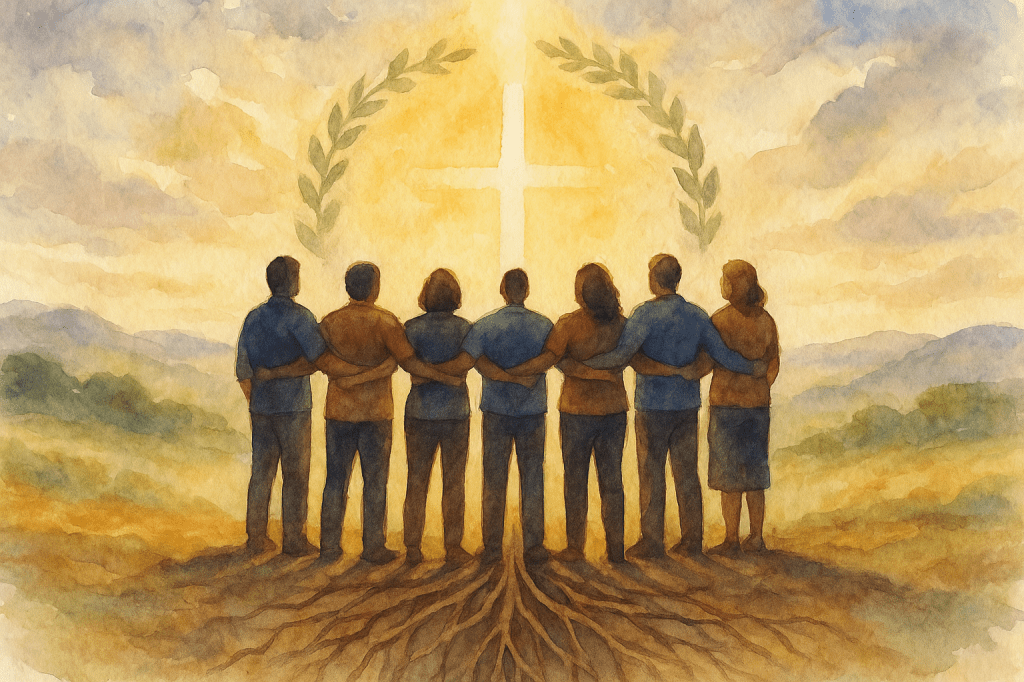
First, citizenship speaks to duty. In earthly civic life we obey laws, pay taxes, serve on juries, vote, stay informed. In the same way, our heavenly citizenship carries responsibilities, not just benefits. Today, citizenship talk often centers on benefits. I’ve seen it up close: many reacquire Philippine citizenship primarily for property rights. Benefits matter, but if that is all citizenship means, something vital is lost. Many Christians think of heavenly citizenship the same way—deliverance from hell, mansions in glory, and for some, invented “benefits” like guaranteed wealth and health. But Scripture calls us to responsibilities too: “Walk in a manner worthy of the calling to which you have been called” (Eph. 4:1). Benefits are real and glorious; duty is real, too.

Second, citizenship warns against dual allegiances. Roman citizenship in Paul’s day was costly and coveted (see Acts 22:27–28), and it could easily eclipse heavenly priorities. Paul redirects the Philippians: live according to the gospel, not the shifting demands of society. We see what happens when churches let society set the agenda. I think of a nearby congregation that once had a self-professed atheist minister and now organizes around values untethered from the gospel. It looks more like a social club—nice people, a knitting circle—but with little affection for Jesus. What’s the point of meeting weekly if not to know, love, and obey Christ? When earthly agendas dominate, gospel unity dissolves.

What happens when we are united in the gospel? Paul says it plainly: “…not frightened in anything by your opponents” (Phil. 1:28). Gospel unity produces courage because it provokes opposition. The very existence of a holy, united church is “a clear sign… of their destruction, but of your salvation, and that from God” (v. 28). That’s hard truth. The gospel divides. As John 3:36 says, “Whoever believes in the Son has eternal life; whoever does not obey the Son shall not see life, but the wrath of God remains on him.” No wonder the world pushes back.

Yet we need not fear. “Fear not, for I am with you” (Isa. 41:10). “God gave us a spirit not of fear but of power and love and self-control” (2 Tim. 1:7). And Paul goes further: suffering for Christ is not an accident; it is a gift. “For it has been granted to you that for the sake of Christ you should not only believe in him but also suffer for his sake” (Phil. 1:29). How can suffering be a gift? Because it brings reward: “Blessed is the man who remains steadfast under trial… he will receive the crown of life” (Jas. 1:12). Because it re-weights our hearts: “This light momentary affliction is preparing for us an eternal weight of glory beyond all comparison” (2 Cor. 4:17). And because it shapes us now: “We rejoice in our sufferings, knowing that suffering produces endurance, and endurance produces character, and character produces hope… because God’s love has been poured into our hearts through the Holy Spirit” (Rom. 5:3–5).

We don’t have to look far to see a world groaning—earthquakes, storms, disease, lonely deaths. I recently watched a story from a Japanese cleaning company that specializes in “kodokushi,” lonely deaths where people go undiscovered for weeks. The owner, also a Buddhist monk, performed rites and told a grieving sister he hoped her brother would enter Nirvana. She replied, “I hope he is able to enter heaven.” That aching uncertainty is everywhere apart from Christ. The world is full of suffering; we need the living hope of the gospel, and we need each other—united—to endure and witness.

How then do we maintain gospel unity? Paul repeats himself for emphasis: “Complete my joy by being of the same mind, having the same love, being in full accord and of one mind” (Phil. 2:2). He knows division can destroy a church. He pleads elsewhere, “that there be no divisions among you… for it has been reported to me… that there is quarreling among you” (1 Cor. 1:10–11). Unity is not optional; it is essential to faithfulness and mission.

And he tells us how, with simple, searching commands: “Do nothing from selfish ambition or conceit, but in humility count others more significant than yourselves. Let each of you look not only to his own interests, but also to the interests of others” (Phil. 2:3–4). That’s the way. Lay down selfish ambition. Refuse conceit. Cultivate humility. Consider others as more significant. Look to their interests. If each of us looks out for the others, all needs are met and unity is preserved.

It also happens to be Thanksgiving. Gratitude steadies unity. “Therefore let us be grateful for receiving a kingdom that cannot be shaken, and thus let us offer to God acceptable worship with reverence and awe” (Heb. 12:28–29). We have received an unshakable kingdom. So, let’s live as heavenly citizens worthy of the gospel, stand firm in one Spirit, strive side by side, refuse fear, embrace the gift of suffering, and, in humility, look to the interests of one another—with reverence, awe, and thanksgiving.
Abraham’s Test and Christ’s Fulfillment

Summary of my sermon, based on Genesis 22:1-14. Preached at Greenhills Christian Fellowship York on August 31, 2025.

Music captures attention, sets the tone, stirs the affections, and helps us remember truth. The Psalms repeatedly command it: “Oh sing to the Lord a new song.” Many Sundays we might forget a sermon outline but carry a line of a hymn all week. That’s not an excuse for poor preaching; it’s a reminder of how powerfully God uses singing in worship.

To think more deeply about worship, we turn to the first mention of the word in Scripture: Genesis 22. There we learn, first, that worship is a response. God speaks, and Abraham answers, “Here I am” (Gen 22:1). We don’t initiate worship; God calls, commands, and invites. Romans 12:1 says, “Therefore… present your bodies… this is your spiritual worship.” The “therefore” points back to who God is (Rom 11:33–36). He deserves it.

Second, worship requires preparation. Abraham rose early, saddled the donkey, split the wood, selected companions, and traveled three days (Gen 22:3–4). Leaders prepare setlists and slides; musicians practice for years. But all of us must also prepare our hearts. Life distracts and wounds. That’s why Jesus says, “Come to me… and I will give you rest” (Matt 11:28–30).

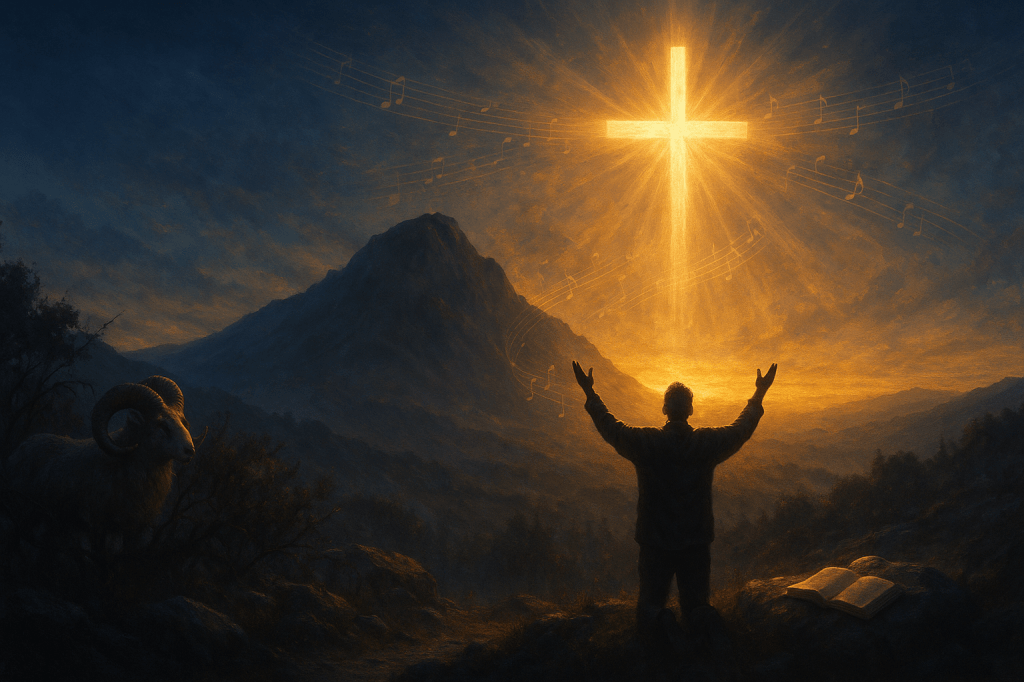
Yet here’s the heart of it: Worship is Christ-centered. On the way up Moriah, Abraham told his servants, “I and the boy will go… we will worship, and we will come again” (Gen 22:5). How could he say that when God had commanded him to offer Isaac? Hebrews 11 explains: Abraham considered that God could raise the dead (Heb 11:17–19). And when the knife was raised, God provided a substitute—a ram caught in a thicket (Gen 22:11–13). Moriah points us to Calvary, to the Lamb of God who takes away the sin of the world.

Jesus is our Passover Lamb (John 1:29; 1 Cor 5:7). “He was pierced for our transgressions… and by his wounds we are healed” (Isa 53:5). Because he “became obedient to the point of death—even death on a cross,” God “highly exalted him,” so that at the name of Jesus every knee bows and every tongue confesses he is Lord (Phil 2:8–11). We worship Jesus not merely because he inspires us, but because he saved us. The cross is the ground of his unique worthiness and the reason heaven’s song declares, “Worthy is the Lamb who was slain” (Rev 5:12).

Left to ourselves, our hearts are “idol factories,” crafting gods in our own image or offering God lip service while our hearts are far away (Matt 15:7–9). The cross changes that. There, Jesus not only purchases our forgiveness; he wins our affection and grants us access. The cross is the objective evidence of God’s love. Whatever burden you carry—grief, doubt, the “dark night of the soul”—hear his invitation: “Come to me… and I will give you rest” (Matt 11:28). Because God’s wrath was poured out on Jesus, there is none left for those in him. So we don’t just admire Christ—we are drawn to adore him. The Spirit takes the finished work of the Son and turns reluctant people into willing worshipers.

Lift your eyes, then, from Moriah to heaven’s throne room: “Worthy is the Lamb who was slain… To him be blessing and honor and glory and might forever and ever!” (Rev 5:11–14). That is where our singing on earth is headed.

In summary: Worship begins as God’s call and our response, deepened by intentional preparation. But it finds its center and power in Christ crucified and risen. We worship because of the cross—Jesus is worthy—and we worship through the cross—Jesus makes us willing and able. Turn your eyes upon Jesus; look full in his wonderful face, and let the things of earth grow strangely dim in the light of his glory and grace.

Daring to Draw Near

Summary of my sermon, based on Hebrews 4:14-16. Preached at Greenhills Christian Fellowship Toronto on August 10, 2025.

Hebrews 4:14–16 is one of the richest invitations in Scripture: “Since then we have a great high priest who has passed through the heavens, Jesus, the Son of God, let us hold fast our confession. For we do not have a high priest who is unable to sympathize with our weaknesses, but one who in every respect has been tempted as we are, yet without sin. Let us then with confidence draw near to the throne of grace, that we may receive mercy and find grace to help in time of need.”

The word “dare” might make us think of childish games or thrill-seeking stunts, but in the Christian life, daring takes on a holy meaning. To “dare to draw near” is not reckless—it’s courageous faith. It’s coming boldly before God because Jesus, our great High Priest, has made the way open.

In the Old Testament, the high priest was the mediator between God and Israel. Only once a year, on the Day of Atonement, could he enter the Holy of Holies to offer a sacrifice for the sins of the people. The regulations were strict: he had to be from the line of Aaron, be without physical defect, and follow detailed purity laws. Even then, before stepping into God’s presence, he had to atone for his own sins through an elaborate, bloody ritual. If he entered carelessly or unworthily, he would die in the presence of a holy God.

But Jesus is different. He is called the “great” High Priest because He did not just offer a yearly sacrifice—He offered Himself once and for all. His death, burial, and resurrection completed the work forever. As Hebrews 10:12 says, “When Christ had offered for all time a single sacrifice for sins, he sat down at the right hand of God.” There is no need for repetition; His work is finished.

Even more, Jesus is not a distant priest. He knows our struggles. He was tempted in every way, yet without sin. He knows hunger, exhaustion, loneliness, betrayal, grief, and physical pain. He faced the schemes of the devil and the sting of abandonment. When we bring our burdens—whether guilt from past mistakes, physical ailments, mental battles, or spiritual struggles—He understands. He doesn’t merely offer mercy from afar; He offers it with the compassion of one who has walked our path.

Because of this, we can pray boldly. Prayer can be hard—our minds wander, our words fail—but we are not left without help. We can use the prayers of faithful believers from the past, the written words of saints who poured out their hearts to God. Tools like “The Valley of Vision” or daily liturgies can guide us. We can also use practical reminders, like praying in concentric circles—starting with family, then our church and workplace, then the wider world.

Whatever method we use, the heart of it is this: Jesus has opened the way. We can dare to approach the throne of grace with confidence, knowing we will find mercy and help in our time of need. The One who receives us there knows exactly what we are going through—and He will never turn us away.

Called Out of Darkness

Summary of my sermon, based on 1 Peter 2:9-11. Preached at Greenhills Christian Fellowship Toronto (Family Camp) on July 20, 2025.

Being chosen by God is not like being the best option in a lineup. It is not like a trainer in a game looking for the strongest fighter. We often think of choice as selecting what is most valuable or most useful. That is how life usually works—we look for the best job, the best school, the best home, and we teach our children to make good choices. But when we read passages like 1 Peter 2:9, we have to be careful. “But you are a chosen race, a royal priesthood, a holy nation, a people for his own possession…” It sounds like we must be special. It sounds like we are chosen because we are better. But then Peter explains why God chooses: “that you may proclaim the excellencies of him who called you out of darkness into his marvelous light.” The choosing is not because of what we are; it is about what he does.

We are called out of darkness, not because we were shining gems hidden in a cave, but because we needed mercy. Verse 10 says, “Once you were not a people, but now you are God’s people; once you had not received mercy, but now you have received mercy.” Mercy means we are not getting what we deserve. And grace—the other side of salvation—means we are receiving what we do not deserve. We needed mercy because before a perfectly holy God, none of us measures up. Even our best efforts fall short. Isaiah 64:6 describes our righteous deeds as polluted garments. Romans 3:23 says, “for all have sinned and fall short of the glory of God,” and Romans 6:23 adds, “the wages of sin is death, but the free gift of God is eternal life in Christ Jesus our Lord.”

God’s choosing is not about our worth. It is about his grace. He sent his Son, Jesus Christ, who met God’s perfect standard and then took the punishment we deserved. Isaiah 53:5 says, “he was pierced for our transgressions; he was crushed for our iniquities; upon him was the chastisement that brought us peace, and with his wounds we are healed.” Romans 5:8 reminds us, “but God shows his love for us in that while we were still sinners, Christ died for us.” That is what it means to be chosen. It means we are loved despite our failures, saved by mercy, and transformed by grace.

If that is true, then being chosen changes how we live. We cannot claim God’s mercy and then live as though nothing has changed. Peter calls believers “sojourners and exiles” because this world is no longer our home. We are passing through, heading toward eternity with Christ. While we are here, we are called to “abstain from the passions of the flesh, which wage war against your soul” (1 Peter 2:11). Sin still surrounds us and tempts us, but sanctification—the ongoing work of God in us—calls us to fight against it. We will not be perfect in this life, but we are expected to grow. Our choices reveal who we belong to—sin, or Christ.

And as we live as sojourners, we are not meant to hide from the world. Verse 12 says, “Keep your conduct among the Gentiles honorable, so that when they speak against you as evildoers, they may see your good deeds and glorify God.” We are called to live visibly, to show mercy because we have received mercy, to demonstrate grace because grace was given to us. We are not chosen to boast about ourselves. We are chosen to proclaim his excellencies, to be witnesses in a world that still needs the same mercy we were given.

Being Mothers of the Word

Summary of my sermon, based on Deuteronomy 6:6-7. Preached at Greenhills Christian Fellowship Toronto on May 11, 2025 (Mother’s Day).

Last week, Elder John Greg preached on God’s call to Moses from the burning bush and described it as Moses’s origin story. But today, I want to rewind even further and look at the very beginning of that story—Moses’s birth and childhood. I want us to see how someone like Moses grew up to become a man of such faith that he would rather be mistreated with the people of God than enjoy the fleeting pleasures of sin. That’s what Hebrews 11:24–25 tells us: “By faith Moses, when he was grown up, refused to be called the son of Pharaoh’s daughter, choosing rather to be mistreated with the people of God.” But where did that faith come from? How did Moses even know he wasn’t Egyptian? How did he know enough about the God of Israel to make such a costly choice?

To answer that, we go back to Exodus 1. Pharaoh had commanded that every Hebrew baby boy be killed, but the Hebrew midwives, Shiprah and Puah, feared God and refused. Then in Exodus 2, Moses is born. His mother hides him for three months, and when she can no longer hide him, she places him in a basket and sends him down the Nile—technically obeying Pharaoh’s command to cast him into the river. His sister follows the basket, watching over it until Pharaoh’s daughter finds it. And when the princess opens the basket, she knows immediately that this is one of the Hebrew babies. That’s when Miriam, Moses’s sister, bravely steps forward and suggests finding a Hebrew woman to nurse the child—and of course, she goes and gets their mother, Jochebed.

That’s where everything changes. Pharaoh’s daughter not only agrees but offers to pay Jochebed to raise her own son. God’s providence is so evident here. And although Jochebed is not named in Exodus 2, we find her name later in Exodus 6:20. It’s Jochebed who gets to nurse Moses, to raise him in his earliest years, and to teach him who he really is. Before he ever returns to Pharaoh’s household and receives an Egyptian education, Moses learns that he is a child of Abraham, Isaac, and Jacob. He learns to trust in the God of Israel. And those early lessons are what shaped his identity and formed the faith we see described in Hebrews 11.

Even though Moses eventually returns to the palace, he never forgets who he is. Exodus 2:11 says, “One day, when Moses had grown up, he went out to his people and looked on their burdens.” Did you catch that? His people. Jochebed planted that in his heart. That’s why, later in life, he chose to suffer with his people rather than enjoy the palace’s comforts. That’s also why Hebrews 11:23 says, “By faith Moses, when he was born, was hidden for three months by his parents… they were not afraid of the king’s edict.” She’s not named here either, but we know who that was. That was Jochebed. She’s part of the Hall of Faith.

And today, on Mother’s Day, we tell this story not just to honour biological mothers like Jochebed but also the many women who act as motherly figures in the lives of others. Women like the midwives Shiprah and Puah, who feared God. Women like Miriam, who watched over her baby brother and spoke up boldly. Even Pharaoh’s daughter, who took a Hebrew baby as her own, defying her father’s deadly command. God used each of them to raise up the man who would lead Israel out of slavery.

And so we turn to our passage this morning from Deuteronomy 6:6–7: “And these words that I command you today shall be on your heart. You shall teach them diligently to your children…” These verses were given to all of Israel, not just to mothers. But Proverbs 6:20 reminds us, “My son, keep your father’s commandment, and forsake not your mother’s teaching.” Mothers and spiritual mothers alike have a high calling. We are to store God’s word in our hearts like Psalm 119:11 says, teach it diligently like Deuteronomy commands, and display it prominently in our lives and homes. Because the faith that leads someone like Moses to make the hard choice begins in the home.