
Skip to content

Excel Still More

  • Home
  • Sermons
  • GCF Toronto
  • Service Livestreams

Tag: Biblical Social Justice

Posted on November 27, 2025December 8, 2025

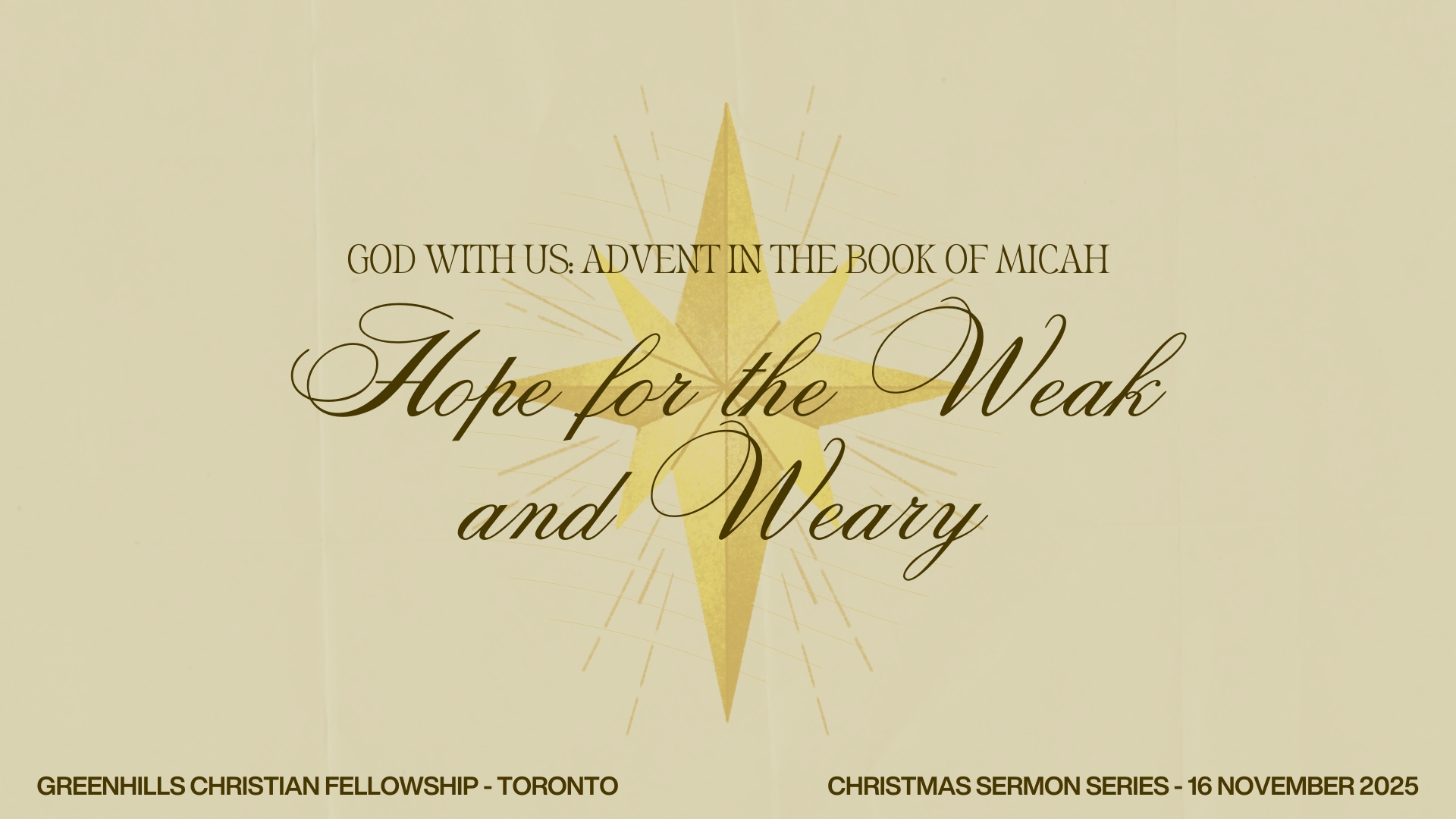
Hope for the Weak and Weary

Summary of my sermon, based on Micah 4. Preached at Greenhills Christian Fellowship Toronto on November 16, 2025.

It’s a blessing to be back at La Marche. Praise the Lord for this place, and praise the Lord for the fall. Let me start with these lyrics:

Imagine all the people living life in peace…
You may say I’m a dreamer, but I’m not the only one.
I hope someday you’ll join us, and the world will be as one.

John Lennon’s “Imagine” (1971) is one of the most famous songs in the world. BMI called it one of the most performed songs of the 20th century. Rolling Stone once ranked it #3 of the 500 greatest songs. The U.S. National Recording Registry preserved it for being culturally, historically, and aesthetically significant. (To be honest, I’m not sure how significant that is—“Livin’ la Vida Loca” also made the list.)

You can see why the song is popular: it expresses the desire for peace and unity. The problem is how Lennon thought peace might be achieved:

Imagine there’s no heaven… no countries…
Nothing to kill or die for… and no religion too.

That’s his vision of peace—without God and without faith. This hasn’t stopped people from promoting the ideas by skipping the anti-religious parts and keeping the peace lines. It’s a secular “hope” song. But our passage this morning moves in the opposite direction.

We’re in our Christmas series, God With Us: Advent in the Book of Micah. The prophetic books are known for God’s wrath and judgment. Last week, Micah 3 ended with a severe pronouncement:

“Therefore because of you Zion shall be plowed as a field;
Jerusalem shall become a heap of ruins.” (Micah 3:12, ESV)

That judgment is heavy because the land symbolizes Israel’s covenant place with God. Earlier Micah said:

“I will make Samaria a heap in the open country, a place for planting vineyards.” (Micah 1:6, ESV)

Flattened like vineyard land—utter destruction—because of idolatry, and because the powerful were stealing land from the weak. It’s right to talk about judgment. A truly righteous God does not let evil go unpunished. Judgment also shows how bitter sin is, and therefore how glorious salvation is:

“Know and see that it is evil and bitter for you to forsake the LORD your God.” (Jeremiah 2:19, ESV)

Now we turn to Micah 4—a stunning reversal, the prophetic counterpart of hope and deliverance:

“In the latter days the mountain of the house of the LORD shall be established as the highest of the mountains… and peoples shall flow to it.” (Micah 4:1, ESV)

From flattened ruin to the highest mountain. In the ancient world, mountains were treated as sacred places where the gods dwelt. But there is no one like our God (cf. Exodus 15:11). When the LORD’s mountain is lifted up, nations respond:

“Many nations shall come, and say: ‘Come, let us go up to the mountain of the LORD… that he may teach us his ways and that we may walk in his paths.’” (Micah 4:2, ESV)

This echoes God’s original intention in Genesis 12—that in Abraham “all the families of the earth shall be blessed” (Gen. 12:3). As Isaiah says, Israel becomes “a covenant for the people, a light for the nations” (Isaiah 42:6, ESV).

And the result?

“They shall beat their swords into plowshares, and their spears into pruning hooks; nation shall not lift up sword against nation, neither shall they learn war anymore… and no one shall make them afraid.” (Micah 4:3–4, ESV)

This is the peace Lennon can only imagine because his vision has no place for God. True and lasting peace comes only when God is at the center. That’s also why contemporary, man-centered social “solutions” cannot finally heal the world’s wounds. Micah says:

“All the peoples walk each in the name of its god, but we will walk in the name of the LORD our God forever and ever.” (Micah 4:5, ESV)

When will this be fulfilled? Faithful Christians differ (eschatology). Many see the fullest realization in Christ’s millennial reign after the tribulation; others differ. But in part, fulfillment has already begun in Jesus’ first advent:

“To us a child is born… and his name shall be called… Prince of Peace. Of the increase of his government and of peace there will be no end.” (Isaiah 9:6–7, ESV)

Only Jesus brings peace with God and the peace of God:

“The peace of God, which surpasses all understanding, will guard your hearts and your minds in Christ Jesus.” (Philippians 4:7, ESV)

And He gives us a living hope:

“According to his great mercy, he has caused us to be born again to a living hope through the resurrection of Jesus Christ from the dead.” (1 Peter 1:3, ESV)

Our world is starving for this hope. Here in Canada, euthanasia—so-called medical assistance in dying—shows where imagined hope without Christ can lead: disease, death, injustice, despair. At the same time, let’s not pretend the church is free from struggle. Christians pass through valleys, the “dark night of the soul.” Job loss, underemployment, family struggles, grief, waiting, persistent sin. Christians aren’t hopeless, but we walk through valleys—the “dark night of the soul.” A Puritan prayer puts it beautifully:

“Thou hast brought me to the valley of vision,
where I live in the depths but see thee in the heights…
In the daytime stars can be seen from the deepest wells,
and the deeper the wells the brighter thy stars shine.
Let me find thy light in my darkness, thy life in my death,
thy joy in my sorrow, thy grace in my sin, thy riches in my poverty,
thy glory in my valley.”

Situations may feel hopeless, but for those in Christ there is no such thing as hopelessness. In Him we have forgiveness of sins; in Him we are more than conquerors; in Him God works all things together for our good and His glory.

Micah also shows whom God gathers in His restoration:

“I will assemble the lame and gather those who have been driven away and those whom I have afflicted; and the lame I will make the remnant, and those who were cast off, a strong nation; and the LORD will reign over them in Mount Zion from this time forth and forevermore.” (Micah 4:6–7, ESV)

God lifts the weak and weary, forms a remnant, and through them brings about His purposes, ultimately in the advent of Jesus Christ, the true and final King, the Prince of Peace.

So how do we live this out? James 1:27 gives a clear call:

“Religion that is pure and undefiled before God, the Father, is this: to visit orphans and widows in their affliction, and to keep oneself unstained from the world.” (ESV)

One practical way: partner with Compassion Canada. I support their work because it aligns with what we’ve seen in Micah—child-focused, church-driven, and Christ-centered. Three simple on-ramps:

Sponsor a child. Build a direct, prayerful relationship as they grow through the program.

Give to the Christmas Gift Fund. Every registered child receives a gift and hears the gospel with their family.

Write to your sponsored child. Letters encourage faith, build skills, and communicate the love of Christ.

Let us be a light to the nations in places we cannot physically reach. Only in Christ is there true, lasting peace—and only with God at the center will swords become plowshares, fear give way to rest under the vine and fig tree, and the nations “walk in the name of the LORD our God forever and ever.”

Posted on November 6, 2025November 2, 2025

Promises that Cannot Fail

Summary of my sermon, based on Micah 2. Preached at Greenhills Christian Fellowship Toronto on October 26, 2025.

It’s unexpected that I’m in my heavy winter sweater this morning. The weather gives us a kind of justification for the sermon series we’re in now. As you know from last week, I started our Christmas series, God With Us: Advent in the Book of Micah. I want us to spend a good amount of time in this book so we can draw out the wonderful things we can learn about God.

Last week in chapter one, the prophet Micah gave an initial prophecy I called the Holy One drawing near—judgment against Israel and Judah. The imagery was earthquakes and volcanoes: the God of the universe coming down to judge his creation and, in particular, his people. Yet hundreds of years after Micah, God drew near again—this time not with earthquakes and volcanoes, but with a silent night: the Word became flesh in Jesus Christ.

It is fitting to talk about God’s judgment, because only a truly good God judges evildoers. If people can do evil without consequences, we lose any concept of right and wrong—might would make right, and only the strongest would flourish. Praise the Lord that he judges evil. The problem people have with God’s wrath is that it turns toward us. Everyone loves justice until that justice is against you. “For all have sinned and fall short of the glory of God” (Romans 3:23). “For the wages of sin is death, but the free gift of God is eternal life in Christ Jesus our Lord.” (Romans 6:23) Without judgment and wrath, there is no need for the gospel. But God does judge evil—therefore we do need a Savior.

The broad prophetic complaint is idolatry. “Who is like you, O LORD, among the gods? Who is like you, majestic in holiness, awesome in glorious deeds, doing wonders?” (Exodus 15:11) Yet “although they knew God, they did not honor him as God or give thanks to him, but they became futile in their thinking, and their foolish hearts were darkened.” (Romans 1:21) This is the basic sin of humanity from which other sins flow.

In Micah 2, a specific sin surfaces:

“Woe to those who devise wickedness and work evil on their beds!
When the morning dawns, they perform it, because it is in the power of their hand.
They covet fields and seize them, and houses, and take them away;
they oppress a man and his house, a man and his inheritance.” (Micah 2:1–2)

Elites plot to seize the land of their fellow Israelites—likely the poorest and most oppressed. This brings us to social justice in Micah. “He has told you, O man, what is good; and what does the LORD require of you but to do justice, and to love kindness, and to walk humbly with your God?” (Micah 6:8) That is absolutely an issue: the rich oppressing the poor, the needy neglected. But I want to be cautious not to conflate contemporary social justice with biblical social justice.

Here is the emphasis: contemporary social justice is entirely man-centered—all about human structures and human solutions. Biblical social justice has both social and theological aspects: social and theological wrongs, with social and theological resolutions. The social aspect is obvious: the rich steal land; people have their inheritance taken. The theological aspect appears in Micah’s wording: they covet. He doesn’t merely say they want fields; he calls it coveting—the Tenth Commandment: “You shall not covet your neighbor’s house… or anything that is your neighbor’s.” (Exodus 20:17) Micah intentionally ties this to the Ten Commandments as a whole.

Think of the commandments as vertical (first four: our duty to God) and horizontal (last six: our duty to one another). Keep the vertical, and the horizontal follows. Jesus said: “You shall love the Lord your God with all your heart and with all your soul and with all your mind. This is the great and first commandment. And a second is like it: You shall love your neighbor as yourself. On these two commandments depend all the Law and the Prophets.” (Matthew 22:37–40) To break the horizontal is to break the vertical. So David confesses, “Against you, you only, have I sinned and done what is evil in your sight.” (Psalm 51:4)

There is more. Land in Israel is not merely property; it is inheritance—a covenant sign of God’s relationship with his people. God’s promise to Abram: “To your offspring I will give this land.” (Genesis 12:7) This is codified in Israel’s law through the Jubilee: “In this year of jubilee each of you shall return to his property. And if you make a sale to your neighbor or buy from your neighbor, you shall not wrong one another.” (Leviticus 25:13–14) And the foundation: “The land shall not be sold in perpetuity, for the land is mine. For you are strangers and sojourners with me.” (Leviticus 25:23) To steal land is to tamper with a covenant sign; it is not only theft, it is rebellion against God.

Therefore the judgment:

“Behold, against this family I am devising disaster, from which you cannot remove your necks…
‘We are utterly ruined; he changes the portion of my people; how he removes it from me!
To an apostate he allots our fields.’
Therefore you will have none to cast the line by lot in the assembly of the LORD.” (Micah 2:3–5)

The yoke image is control you cannot throw off—foreign power, exile. Judgment extends to all Judah because the specific sin sits inside widespread idolatry. Yet notice the last line: the land-grabbers will have no advocate in the assembly of the LORD. That hints at hope: if there is an assembly to come, there will be a people to assemble.

But the rot deepens: false prophets say, “Do not preach”—they bless what God condemns. “Woe to those who call evil good and good evil.” (Isaiah 5:20) Here is a present example: the health, wealth, and prosperity gospel. As John MacArthur says, “Where does the prosperity gospel come from? Answer: Satan… This is satanic… the fulfillment of all your dreams and all your desires… the lust of the flesh, the lust of the eyes, and the pride of life… turning temptations into somehow honorable desires.” It works because it plays into unregenerate desires—turning evil “good.” Some of the largest churches preach it. As culture in places like America grows more secular, prosperity preachers turn to the developing world—the Philippines, Africa—preying on the poor. (See, for example, Mike Winger’s long-form work calling out Benny Hinn.) In effect, they steal from the poor while distorting the gospel, making it harder for true believers to preach the true gospel.

God does not promise health, wealth, and ease; he promises his presence in suffering and ultimate restoration. “After you have suffered a little while, the God of all grace… will himself restore, confirm, strengthen, and establish you.” (1 Peter 5:10) The true gospel is that Christ died to reconcile us to God, not to deliver our wishlist. “For Christ also suffered once for sins, the righteous for the unrighteous, that he might bring us to God.” (1 Peter 3:18)

And Micah does not end in despair:

“I will surely assemble all of you, O Jacob; I will gather the remnant of Israel;
I will set them together like sheep in a fold, like a flock in its pasture…
He who opens the breach goes up before them… their king passes on before them, the LORD at their head.” (Micah 2:12–13)

A remnant will be gathered under a Shepherd–King. Jesus comes as the good shepherd who gathers, guides, and lays down his life for the sheep. Biblical social justice does not terminate on systems; it leads to the cross—to God giving his Son for us. It does not end with man-centered fixes (it doesn’t end with, say, pronouns in your LinkedIn profile); it ends with atonement and a new people who do justice, love kindness, and walk humbly with their God.

We praise the Lord for the cross. We thank him that he has not given us merely temporal solutions to the problems of a fallen, broken world, but the once-for-all sacrifice of Christ, the promise that we will be made alive with him for eternity.

Finally then, brethren, we request and exhort you in the Lord Jesus, that as you received from us instruction as to how you ought to walk and please God (just as you actually do walk), that you excel still more.

1 Thessalonians 4:1
  • Bethlehem’s Unexpected King
  • Bear with One Another
  • Hope for the Weak and Weary
  • The Price of Injustice
  • Greet One Another With a Holy Kiss
  • Books of the Bible (98)
    • 1 John (14)
    • 1 Peter (1)
    • 1 Samuel (1)
    • 1 Thessalonians (1)
    • 2 Corinthians (2)
    • 2 Kings (1)
    • Colossians (3)
    • Daniel (1)
    • Deuteronomy (1)
    • Ecclesiastes (1)
    • Ephesians (1)
    • Esther (1)
    • Galatians (1)
    • Genesis (7)
    • Hebrews (1)
    • Isaiah (1)
    • John (1)
    • Jonah (1)
    • Joshua (1)
    • Judges (1)
    • Luke (34)
    • Malachi (1)
    • Matthew (7)
    • Micah (5)
    • Philippians (1)
    • Psalm (3)
    • Romans (5)
  • Church (1)
  • Sermons (97)
    • 1 John Series (14)
    • A Light in the Darkness (11)
    • Biblical Stewardship (3)
    • God With Us: Advent in the Book of Micah (5)
    • He is Greater (14)
    • Journey to Jerusalem (10)
    • Miracles of Jesus (4)
    • O Come (5)
    • Sermon on the Plain (5)
    • Stand Alone (11)
    • The One Another Commands (8)
    • Thou Long Expected (4)
    • Treasures in Heaven (3)
  • Writing Prompts (1)

Advent Assurance of Eternal Life Assurance of salvation Authority of Jesus Biblical Discernment Biblical Theology Christian Discipleship Christian Living Christian Unity Christmas Church confidence Disappointment from Idols Diversity and Unity Faith Faith and Humility Faith and Obedience Faith and Work Faith in Action Generosity God's love God With Us God’s Sovereignty in Adversity Gospel Assurance Healing and hope idolatry Jesus as Messiah joy Knowing Jesus Living Out the Gospel Love one another Obedience One Another COmmands Power Perfected in Weakness prayer Salvation Spiritual Growth Star of Bethlehem Trusting God's Strength Typology and Tension Upside Down Kingdom Victory over Evil Word of Life Worship Worshiping Jesus

Create a website or blog at WordPress.com
  • Subscribe Subscribed
    • Excel Still More
    • Already have a WordPress.com account? Log in now.
    • Excel Still More
    • Subscribe Subscribed
    • Sign up
    • Log in
    • Report this content
    • View site in Reader
    • Manage subscriptions
    • Collapse this bar