United in the Gospel

Summary of my sermon, based on Philippians 1:27-2:4. Preached at Greenhills Christian Fellowship Toronto on October 12, 2025.

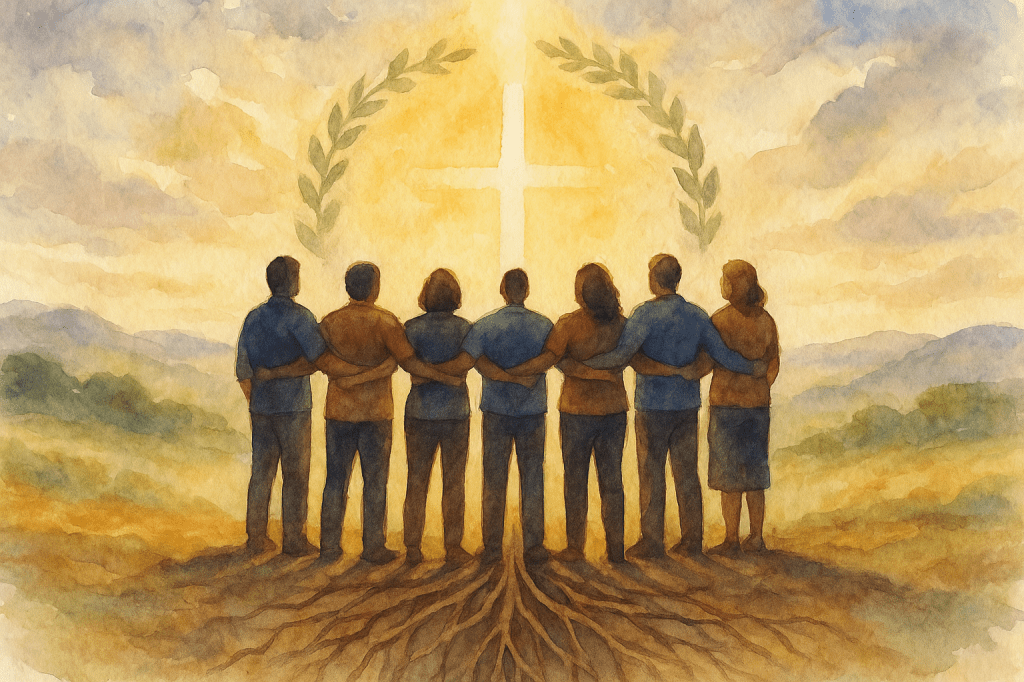
Our text is Philippians 1:27–2:4. Hear Paul’s charge (ESV): “Only let your manner of life be worthy of the gospel of Christ, so that whether I come and see you or am absent, I may hear of you that you are standing firm in one spirit, with one mind striving side by side for the faith of the gospel, and not frightened in anything by your opponents… So if there is any encouragement in Christ, any comfort from love, any participation in the Spirit, any affection and sympathy, complete my joy by being of the same mind, having the same love, being in full accord and of one mind… Do nothing from selfish ambition or conceit, but in humility count others more significant than yourselves. Let each of you look not only to his own interests, but also to the interests of others.”

Unity is fragile. I remember where I was on September 11, 2001—how a moment galvanized nations. Yet the legacy of the “war on terror” is complicated. Mission creep set in: Afghanistan led to Iraq, “freedom fries” replaced French fries in some restaurants, and “mission accomplished” was declared far too soon. Two decades later, Afghanistan returned to Taliban control. That’s what mission creep does—when objectives drift, unity fractures. And this isn’t just geopolitics; it happens to churches. When our mission creeps away from the gospel, unity crumbles.

Paul gives us the basis of gospel unity: “Only let your manner of life be worthy of the gospel of Christ.” The phrase translated “manner of life” reflects a citizenship idea (politeuesthe)—live as citizens. He’s cueing what he’ll say later: “But our citizenship is in heaven” (Phil. 3:20). Read 1:27 like this: “Let your conduct as heavenly citizens be worthy of the gospel.” Why this framing?
First, citizenship speaks to duty. In earthly civic life we obey laws, pay taxes, serve on juries, vote, stay informed. In the same way, our heavenly citizenship carries responsibilities, not just benefits. Today, citizenship talk often centers on benefits. I’ve seen it up close: many reacquire Philippine citizenship primarily for property rights. Benefits matter, but if that is all citizenship means, something vital is lost. Many Christians think of heavenly citizenship the same way—deliverance from hell, mansions in glory, and for some, invented “benefits” like guaranteed wealth and health. But Scripture calls us to responsibilities too: “Walk in a manner worthy of the calling to which you have been called” (Eph. 4:1). Benefits are real and glorious; duty is real, too.

Second, citizenship warns against dual allegiances. Roman citizenship in Paul’s day was costly and coveted (see Acts 22:27–28), and it could easily eclipse heavenly priorities. Paul redirects the Philippians: live according to the gospel, not the shifting demands of society. We see what happens when churches let society set the agenda. I think of a nearby congregation that once had a self-professed atheist minister and now organizes around values untethered from the gospel. It looks more like a social club—nice people, a knitting circle—but with little affection for Jesus. What’s the point of meeting weekly if not to know, love, and obey Christ? When earthly agendas dominate, gospel unity dissolves.

What happens when we are united in the gospel? Paul says it plainly: “…not frightened in anything by your opponents” (Phil. 1:28). Gospel unity produces courage because it provokes opposition. The very existence of a holy, united church is “a clear sign… of their destruction, but of your salvation, and that from God” (v. 28). That’s hard truth. The gospel divides. As John 3:36 says, “Whoever believes in the Son has eternal life; whoever does not obey the Son shall not see life, but the wrath of God remains on him.” No wonder the world pushes back.

Yet we need not fear. “Fear not, for I am with you” (Isa. 41:10). “God gave us a spirit not of fear but of power and love and self-control” (2 Tim. 1:7). And Paul goes further: suffering for Christ is not an accident; it is a gift. “For it has been granted to you that for the sake of Christ you should not only believe in him but also suffer for his sake” (Phil. 1:29). How can suffering be a gift? Because it brings reward: “Blessed is the man who remains steadfast under trial… he will receive the crown of life” (Jas. 1:12). Because it re-weights our hearts: “This light momentary affliction is preparing for us an eternal weight of glory beyond all comparison” (2 Cor. 4:17). And because it shapes us now: “We rejoice in our sufferings, knowing that suffering produces endurance, and endurance produces character, and character produces hope… because God’s love has been poured into our hearts through the Holy Spirit” (Rom. 5:3–5).

We don’t have to look far to see a world groaning—earthquakes, storms, disease, lonely deaths. I recently watched a story from a Japanese cleaning company that specializes in “kodokushi,” lonely deaths where people go undiscovered for weeks. The owner, also a Buddhist monk, performed rites and told a grieving sister he hoped her brother would enter Nirvana. She replied, “I hope he is able to enter heaven.” That aching uncertainty is everywhere apart from Christ. The world is full of suffering; we need the living hope of the gospel, and we need each other—united—to endure and witness.

How then do we maintain gospel unity? Paul repeats himself for emphasis: “Complete my joy by being of the same mind, having the same love, being in full accord and of one mind” (Phil. 2:2). He knows division can destroy a church. He pleads elsewhere, “that there be no divisions among you… for it has been reported to me… that there is quarreling among you” (1 Cor. 1:10–11). Unity is not optional; it is essential to faithfulness and mission.

And he tells us how, with simple, searching commands: “Do nothing from selfish ambition or conceit, but in humility count others more significant than yourselves. Let each of you look not only to his own interests, but also to the interests of others” (Phil. 2:3–4). That’s the way. Lay down selfish ambition. Refuse conceit. Cultivate humility. Consider others as more significant. Look to their interests. If each of us looks out for the others, all needs are met and unity is preserved.

It also happens to be Thanksgiving. Gratitude steadies unity. “Therefore let us be grateful for receiving a kingdom that cannot be shaken, and thus let us offer to God acceptable worship with reverence and awe” (Heb. 12:28–29). We have received an unshakable kingdom. So, let’s live as heavenly citizens worthy of the gospel, stand firm in one Spirit, strive side by side, refuse fear, embrace the gift of suffering, and, in humility, look to the interests of one another—with reverence, awe, and thanksgiving.


Called to True Repentance

Summary of my sermon, based on Luke 12:35–48. Preached at Greenhills Christian Fellowship Toronto on September 14, 2025.

This morning we looked at Luke 12:35–40, where Jesus tells His disciples, “Stay dressed for action and keep your lamps burning, and be like men who are waiting for their master to come home from the wedding feast, so that they may open the door to him at once when he comes and knocks.” His message is simple: always be ready. We don’t know the day or the hour of His return, so every moment of our lives ought to be lived in readiness.

The preacher reminded us that this is not a new call for God’s people. Many Christians in the last century looked at world events and believed the Lord’s return was near. On November 29, 1947, the United Nations voted to establish a Jewish homeland after nearly 1,800 years of exile. For Bible-believing Christians, this looked like a direct fulfillment of prophecy, like Amos 9:14–15 where God promised to plant His people back in their land never to be uprooted again. If Israel was back in their homeland, many believed the rapture was just around the corner. Nearly eighty years have passed, and while some things have come to pass, others like the rebuilding of the temple have not. But Scripture reminds us in 2 Peter 3:8–9 that God’s timing is not like ours: “With the Lord one day is as a thousand years, and a thousand years as one day. The Lord is not slow to fulfill his promise as some count slowness, but is patient toward you, not wishing that any should perish, but that all should reach repentance.” What seems slow to us is actually God’s mercy, giving time for more to come to repentance.

Of course, Christians have understood prophecy in different ways. Some see the millennium as a literal thousand years still to come, others see it as symbolic of the present church age, and still others see it as the spread of the gospel before Christ returns. But whatever our viewpoint, one truth remains the same: Jesus is coming again. We may debate the details, but we cannot ignore the command to be ready.

Jesus uses two pictures to describe readiness. He says, “Stay dressed for action,” or as the old translations put it, “gird up your loins.” In those days, men wore long robes that would get in the way of work or travel, so they would tuck them up into their belts so they could move freely. To stay dressed for action means to live ready, unentangled, unhindered, able to obey quickly. Then He says, “Keep your lamps burning.” In other words, don’t let your faith burn low. Don’t grow drowsy in your walk with God. Be alert, be awake, because He could come at any moment.

And then Jesus gives a surprising promise. He says that when the master returns and finds his servants awake, “Truly, I say to you, he will dress himself for service and have them recline at table, and he will come and serve them.” That is astonishing. The servants are the ones who ought to serve, but here the Master serves them. What a picture of the blessing Christ will give to those who remain faithful and ready.

But there is also a sobering side. Jesus says His coming will be like a thief in the night. You don’t get a calendar notice for when a thief will show up; he comes suddenly. That’s how Christ’s return will be—unexpected, swift, like lightning flashing across the sky.

Peter wanted to know if this warning was just for the apostles, but Jesus’ answer shows it is for everyone. Every servant will give an account. The servant who knows his master’s will and ignores it will be judged severely. The one who is careless with what he has been given will also be held responsible. And then Jesus lays down the principle: “Everyone to whom much was given, of him much will be required.” Week after week we hear the Word of God. That is a gift, but it also carries responsibility. We cannot treat His Word lightly.

The call is clear. Live watchfully. Keep your faith burning. Be faithful in what God has given you. Christ could come at any moment, or our life could end at any moment. Either way, the question remains: will He find us ready?

Maranatha. Come, Lord Jesus.

Instruct One Another

Summary of my sermon, based on Romans 15:14-16. Preached at Greenhills Christian Fellowship Toronto on September 7, 2025.

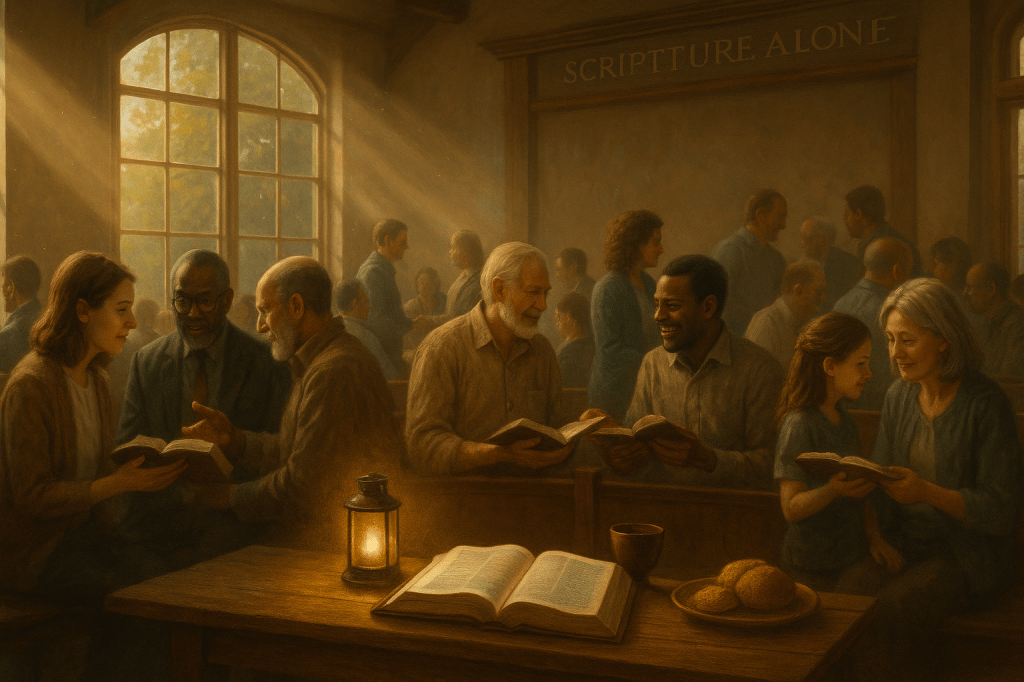
It’s been a little over five hundred years since Martin Luther posted his Ninety-five Theses and sparked the Protestant Reformation. We often summarize that movement with the five solas, but there’s a pastoral thread that can be overlooked: the question of language in worship and in our Bibles. For centuries much of Western Christianity heard Scripture read publicly in Latin—even when few understood it. The Reformers pressed forward the conviction of Scripture alone: if the Bible is our final authority for faith and practice, then God’s people must be able to hear and read it in their own tongue. That conviction helps explain why Luther translated the Bible into German and why, over time, churches moved toward the language of the people.

That ties directly to our text: “I myself am satisfied about you, my brothers, that you yourselves are full of goodness, filled with all knowledge and able to instruct one another” (Romans 15:14, ESV). Paul is not only speaking to pastors; he is addressing the church. Because the gospel has taken root, ordinary believers—indwelt by the Spirit—are able to teach and admonish one another. He adds that he writes “very boldly by way of reminder, because of the grace given me by God to be a minister of Christ Jesus to the Gentiles… so that the offering of the Gentiles may be acceptable, sanctified by the Holy Spirit” (Romans 15:15–16, ESV). Paul’s ministry is by grace, and our mutual ministry is too.

Yesterday I sat in on an Evangelism Explosion preview. One of the guests, Richard, professed faith in Christ—praise God. In another group a man named Greg voiced a familiar objection: a pastor stands at a podium and tells people what to believe. I would answer this way: Christian preaching isn’t someone imposing opinions; it is the Spirit opening the text he inspired. As Paul says, “And we impart this in words not taught by human wisdom but taught by the Spirit, interpreting spiritual truths to those who are spiritual” (1 Corinthians 2:13, ESV). And the sermon is only one hour a week. There are 167 other hours where the command of Romans 15:14 lives—around dinner tables, in small groups, over coffee, on phone calls—where believers gently, humbly bring God’s Word to one another.

Jesus promised this help for all his disciples: “But the Helper, the Holy Spirit, whom the Father will send in my name, he will teach you all things and bring to your remembrance all that I have said to you” (John 14:26, ESV). If you belong to Christ, the Spirit is your Teacher. You are not left to yourself, and you are not disqualified from speaking God’s truth in love.

With that privilege comes a boundary. We do not teach our hunches or preferences; we teach what God has said. “Trust in the Lord with all your heart, and do not lean on your own understanding. In all your ways acknowledge him, and he will make straight your paths. Be not wise in your own eyes; fear the Lord, and turn away from evil. It will be healing to your flesh and refreshment to your bones” (Proverbs 3:5–8, ESV). Peter presses the same point: “And we have the prophetic word more fully confirmed, to which you will do well to pay attention as to a lamp shining in a dark place… knowing this first of all, that no prophecy of Scripture comes from someone’s own interpretation. For no prophecy was ever produced by the will of man, but men spoke from God as they were carried along by the Holy Spirit” (2 Peter 1:19–21, ESV). The Spirit who inspired the Word never contradicts the Word.

And here is the purpose: we teach one another so that our lives might be an acceptable offering to God, sanctified by the Holy Spirit (Romans 15:16). Mutual instruction is priestly service. It keeps pointing us back to the gospel—Christ crucified, buried, and risen; repentance and faith; walking by the Spirit. If you want to grow in this calling, begin here: know the gospel and know your Bible. Read it daily. Read it with someone. Memorize a verse you can share this week. Ask, “How does this passage lead me to Christ?” Then look for one concrete opportunity to encourage, correct, or comfort a brother or sister with the Word.

As we come to the Lord’s Table, we remember that “as often as you eat this bread and drink the cup, you proclaim the Lord’s death until he comes” (1 Corinthians 11:26, ESV). Church, you are full of goodness, filled with knowledge, and—by the Spirit—able to instruct one another. Let’s walk in that grace together.

Welcome One Another

Summary of my sermon, based on Romans 15:7-13. Preached at Greenhills Christian Fellowship Toronto on August 3, 2025.

When I arrived at Capernwray, I felt like a fish out of water. Most of the students were from small towns in rural Alberta—white, small-town kids who’d never lived in a city. I was one of only three Asians and definitely the only one from a big city. They nicknamed me “Big City Brown Bear.” Everything about me—from my clothes to my taste in music—set me apart. And yet, despite the differences, I felt completely welcome. Why? Because we all had one thing in common: our faith in Jesus Christ. And when Christ is the center, most differences fade into the background.

That’s how it should be in the church. But the truth is, we often argue about small things—things that shouldn’t divide us. That’s why Paul says in Romans 15:7, “Therefore welcome one another as Christ has welcomed you, for the glory of God.” If it were easy to get along, Paul wouldn’t have had to say this. So what was going on?

To understand, we have to look back to Romans 14. There Paul writes, “As for the one who is weak in faith, welcome him, but not to quarrel over opinions” (v.1). That phrase “welcome him” is the same verb Paul uses in 15:7. The issue in Rome wasn’t false teaching—it was disagreement over things like food. Some believers felt free to eat anything. Others, whom Paul refers to as “weak in faith,” ate only vegetables.

Why the restriction? Some think they were avoiding meat sacrificed to idols, like the situation Paul addressed in 1 Corinthians 8. But in Rome, the issue likely had more to do with Jewish Christians trying to keep kosher. Because they had been cut off from the Jewish community for following Christ, they couldn’t get kosher meat—and so they stuck with vegetables. These believers were already being marginalized by their own people. And now, some Gentile Christians were judging or even despising them for their dietary convictions.

Paul is clear: this should not be. “Who are you to pass judgment on the servant of another?” (Romans 14:4). He reminds both groups that “the kingdom of God is not a matter of eating and drinking but of righteousness and peace and joy in the Holy Spirit” (v.17). In other words, don’t let food or tradition cause division. Focus on what truly matters—life in the Spirit.

What’s remarkable is how gracious Paul is here. In his letter to the Galatians, he’s angry because some were insisting that Gentiles follow the Jewish law to be saved. That, Paul says, is a false gospel. But in Romans, the Jewish Christians weren’t trying to impose their views—they were simply trying to live according to their convictions. And the Gentiles were misjudging them. So Paul urges both groups to stop judging and start welcoming.

Romans 15:7 drives the point home: “Welcome one another as Christ has welcomed you.” Christ didn’t wait until we had perfect theology or the right lifestyle. He welcomed us in grace. And that’s how we’re to welcome others—especially when they see things differently. Paul continues, explaining that Jesus came as the Jewish Messiah to confirm God’s promises, “in order that the Gentiles might glorify God for his mercy” (v.9). Then he quotes four Old Testament passages—one each from the Law, the Prophets, and the Writings—showing that Gentiles were always meant to join the Jews in worshiping God.

So what does this mean for us? It’s easy to divide over minor issues—especially convictions that aren’t essential to the Gospel. Protestants have split into countless denominations, often over secondary matters. Even within churches, we can be tempted to look down on each other for our choices—what we listen to, watch, or how we raise our kids. But we’re called to something better.

We need discernment. Paul isn’t saying ignore sin—there’s still a place for lovingly confronting what’s wrong. But he is saying don’t turn personal convictions into dividing lines. Instead, pursue what leads to peace and mutual upbuilding.

That’s why Paul ends with this prayer: “May the God of hope fill you with all joy and peace in believing, so that by the power of the Holy Spirit you may abound in hope” (Romans 15:13). Joy, peace, and hope—those are the marks of a church that truly welcomes like Christ.

Serve One Another

Summary of my sermon, based on Galatians 5:13-15. Preached at Greenhills Christian Fellowship Toronto on July 6, 2025.

When you hear the word “freedom,” what comes to mind? For many people, it’s economic freedom—having enough money to do whatever you want. Whether it’s traveling, taking up hobbies, or just relaxing on a beach, freedom often looks like having no obligations. And while that kind of freedom sounds appealing, it’s often just a dream. In reality, we carve out little moments of freedom—like weekends or holidays—tiny escapes from the things we must do. But this leads to a misunderstanding: that freedom is simply the opposite of obligation. That’s why Galatians 5:13 is so important. Paul writes, “You were called to freedom.” And that very first line pushes against our assumptions. Freedom, according to the Bible, is not something we naturally have. Nor is it something we fight for. It’s something we’re called to—by God.

This brings us to our One Another series. If you’ve been with us since January, you’ll remember that we’ve been working through the “one another” commands of the New Testament—23 in total, though some are repeated. We began with “love one another,” which is repeated more than any other. It’s foundational, the “one command to rule them all.” And it directly connects to today’s command in Galatians 5:13: “through love, serve one another.” Paul goes on in verse 14 to say, “For the whole law is fulfilled in one word: ‘You shall love your neighbor as yourself.’” But that’s not the only “one another” command in this passage. In verse 15, Paul gives a warning: “But if you bite and devour one another, watch out that you are not consumed by one another.”

So what does it mean to be called to freedom? First, it means that freedom doesn’t equal doing whatever we want. Even our most celebrated freedoms—like freedom of speech—have limits. Just try yelling “bomb” on a plane and see how far that freedom goes. Freedom always comes with boundaries. And in Scripture, being “called” to freedom emphasizes that it comes from God. Galatians 1:15–16 tells us that God, by his grace, set Paul apart and called him. In 1 Corinthians 1:24, the message of Christ crucified is foolish to the world, but to those who are called, it is the power and wisdom of God. True freedom is a gift we receive when we are called by God and come to know Christ.

This is why Jesus says in John 8:36, “So if the Son sets you free, you will be free indeed.” And Romans 8:1–2 says that we are free from the law of sin and death. But that doesn’t mean we’re free to sin. In fact, Romans 6:16 warns that if we present ourselves to sin, we become slaves to it. Freedom in Christ isn’t the freedom to do whatever we want—it’s the freedom to obey God. It’s the freedom to live in love and righteousness. That’s why Paul says, “Don’t use your freedom as an opportunity for the flesh.”

Now here’s the warning. Even though we are free from the penalty and power of sin, we still live in a world where the presence of sin is real. That’s why Paul warns us not to bite and devour one another. Because when we do, we’re not acting in freedom—we’re acting like the enemy. 1 Peter 5:8 describes the devil as a roaring lion seeking someone to devour. And when we gossip, manipulate, and turn on each other, we’re reflecting his work—not God’s. That’s why Paul tells us again: use your freedom to serve one another in love.