
Summary of my sermon, based on Luke 12:22-34. Preached at Greenhills Christian Fellowship Toronto on August 24, 2025.
“Therefore I tell you, do not be anxious about your life, what you will eat, nor about your body, what you will put on. For life is more than food, and the body more than clothing” (Luke 12:22–23, ESV). This passage represent a movement from last week’s exhortation, “be on your guard against all covetousness, for one’s life does not consist in the abundance of his possessions” (Luke 12:15) to today’s call: do not be anxious. Jesus turns from those who have to those who have not. Whether it is abundance or need, the message is the same: there’s more to life than things. To the rich: don’t hoard, be generous. To the needy: do not be anxious.
Jesus gives three illustrations. First, “Consider the ravens: they neither sow nor reap, they have neither storehouse nor barn, and yet God feeds them. Of how much more value are you than the birds!” Ravens in Israel were like our city pigeons—plentiful and least appreciated—yet God cares for them. Then Jesus asks, “Which of you by being anxious can add a single hour to his span of life?” Worry drains your energy and changes nothing. It’s the stress we feel when we can’t control what’s happening.” We cannot do “as small a thing” as add an hour to our lives, but God can. He added not just an hour but fifteen years to Hezekiah’s life: “I have heard your prayer… behold, I will add fifteen years to your life.” Anxiety is the opposite of trusting God.
Second, “Consider the lilies, how they grow: they neither toil nor spin, yet I tell you, even Solomon in all his glory was not arrayed like one of these.” Grass and flowers are temporary: “The grass withers, the flower fades, but the word of our God will stand forever.” If God so clothes what is here today and tomorrow is thrown into the oven, how much more will he clothe you, “O you of little faith”? Again, the call is to trust him.
Third, Jesus redirects priorities: “Do not seek what you are to eat and what you are to drink, nor be worried… Instead, seek his kingdom, and these things will be added to you.” This echoes the more familiar wording in Matthew 6: “But seek first the kingdom of God and his righteousness, and all these things will be added to you.” This does not mean every Christian should quit work and rely on almsgiving. Some are called to raise support—missionaries, like those who cannot work except in “tent making” situations—but most are not expected to stop earning. Your job may be God’s way of providing for you, your family, the church, and missionaries. The point is priority: seek first the kingdom.
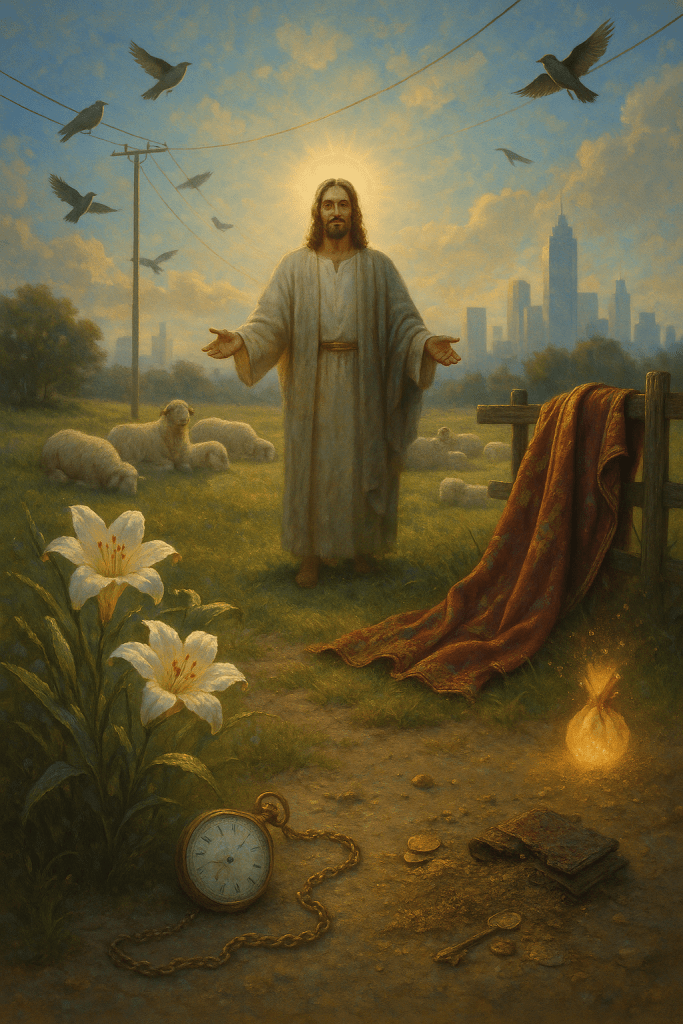
So when Jesus says, “Fear not, little flock, for it is your Father’s good pleasure to give you the kingdom. Sell your possessions, and give to the needy… Provide yourselves with moneybags that do not grow old… For where your treasure is, there will your heart be also,” he is giving the highest standard—a superlative—to make the point. The standard is to put your complete trust in God by making his kingdom the absolute priority. Our priorities are revealed by where our money goes and what we worry about. A “golden child” story illustrates this: where the value is, the resources and thoughts go. Follow your spending and your worries, and you will find your treasure.
When we do not trust God, we lean on ourselves. “Trust in the LORD with all your heart, and do not lean on your own understanding. In all your ways acknowledge him, and he will make straight your paths… Be not wise in your own eyes; fear the LORD, and turn away from evil. It will be healing to your flesh and refreshment to your bones” (Prov. 3:5–8). Not trusting God leads to being wise in our own eyes, not fearing the Lord, and turning toward evil. Bribery shows how both rich and poor can be tempted—whether out of coveting more or out of desperation. A traffic stop in Makati, a suggested bribe, and a 4,000-peso fine show how easy it is to trust in one’s own power rather than in God, and how such corruption keeps a nation in poverty.
This is a high calling, especially for those in need. But the things of this world are fleeting. “Do not love the world or the things in the world… the world is passing away along with its desires, but whoever does the will of God abides forever” (1 John 2:15–17). “If then you have been raised with Christ, seek the things that are above… Set your minds on things that are above, not on things that are on earth” (Col. 3:1–3). You can try to control everything and be consumed by worry, or you can lay it all at the feet of Jesus.
Hear his invitation: “Come to me, all who labor and are heavy laden, and I will give you rest… you will find rest for your souls. For my yoke is easy, and my burden is light” (Matt. 11:28–30). Whether you are in abundance or in need, come to Jesus. His yoke is easy. His burden is light.

 Excel Still More