
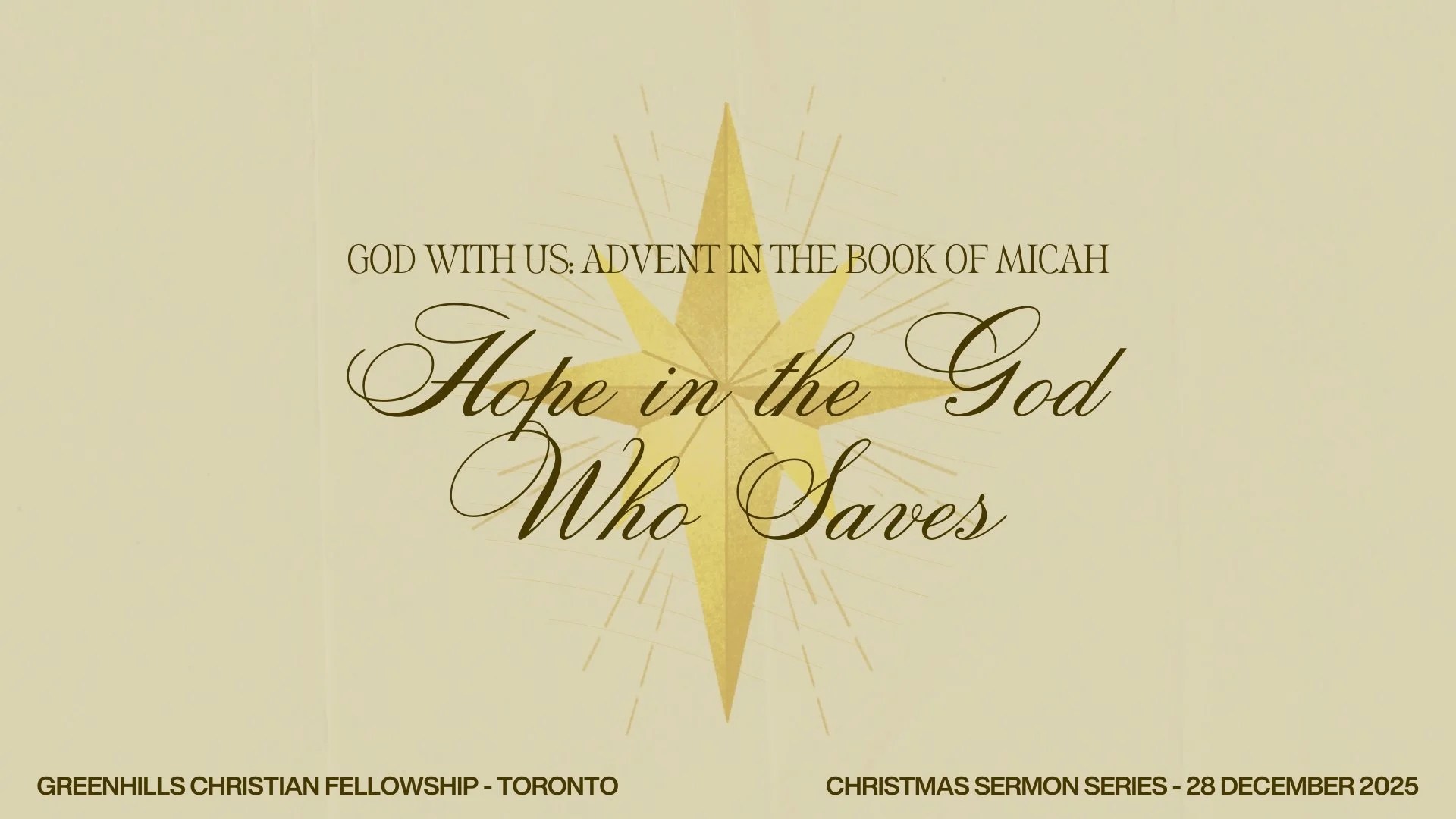
Summary of my sermon, based on Micah 7. Preached at Greenhills Christian Fellowship Toronto on December 28, 2025.
Amen. Praise the Lord. How many of you remember the Y2K scare? It’s wild to think that was twenty-five years ago. I remember my dad, who worked for Manulife Financial, being on call all night on December 31, 1999, because old systems stored the year with just two digits. People worried that when the calendar rolled to “00,” critical computers might fail. From that anxious night to today—when computers can generate images, video, and text—it’s amazing how much has changed.
One change I’m grateful for is YouTube. I use it not only for entertainment but also for long, informative videos. Some can be heavy. One I watched was about a Mexican mother named Miriam whose daughter was kidnapped in 2014. After paying ransom and still losing her daughter, she channeled her grief into relentless investigation—disguises, patient watching, and clever use of social media—identifying everyone involved and working with police to arrest them one by one. She became a symbol of courage in the face of cartel violence and government inaction. Tragically, on Mother’s Day 2017, she was killed near her home, and her own case remains unsolved. Even though I sensed the video might end that way, it left me deflated. Some evil seems to go unpunished—at least on this side of eternity.
That’s close to how the prophet Micah sounds at the start of chapter 7. Near the end of his ministry, despite warnings and promises of hope, he looks around Judah and sees no fruit. The godly seem gone; leaders are corrupt; neighbors and friends can’t be trusted; even families fracture (see Mic 7:1–6). It’s bleak. And it feels familiar: scandals, exploitation, persecution of Christians, and countless other wrongs. Scripture says we should expect difficult times in the “last days,” with people loving self and pleasure rather than God, keeping a form of religion while denying its power (2 Tim 3:1–5). Those who desire to live a godly life in Christ Jesus will be persecuted, while impostors go from bad to worse (2 Tim 3:12–13).
What do we do with that? We can despair or grow cynical, or even start to wonder whether God is really in control. But God is gracious to remind His people of His sovereignty. Think of Elijah. After the dramatic victory over the prophets of Baal (1 Kgs 18), one threat from Jezebel sent him fleeing, discouraged, and ready to give up (1 Kgs 19). God met him, questioned his despair, and reminded him there were seven thousand who hadn’t bowed to Baal (1 Kgs 19:18). Elijah wasn’t alone; God was still ruling.
Micah has a similar turn. Suddenly his tone shifts: “As for me, I will look to the Lord… my God will hear me… When I fall, I shall rise… When I sit in darkness, the Lord will be a light to me” (see Mic 7:7–8). He acknowledges Judah’s sin and the Lord’s indignation, yet trusts that God Himself will plead his cause, bring him into the light, and vindicate His people (Mic 7:9–10). Judgment would come—exile to Babylon—but God promised a remnant, a return, and ultimately a Messiah who would bring complete victory.
That victory arrived in a way no one could have scripted. The prophets dropped clues—Emmanuel, “God with us” (Isa 7:14); the child who is Wonderful Counselor, Mighty God, Everlasting Father, Prince of Peace (Isa 9:6–7)—but the fulfillment exceeded imagination. The Son of God took on flesh and dwelt among us (John 1:14). Everything about Jesus’ birth emphasized lowliness and surprise: the scandal of a betrothed virgin with child, a census forcing travel under foreign rule, a stable for delivery, a manger for a crib, angelic news first announced to shepherds, and wise men initially going to the royal city—not to Bethlehem. God downplayed earthly glory to reveal a greater glory: not merely Israel’s political restoration, but salvation for the world (Gen 12:3; Mic 5:2).
Micah 7 closes with this double horizon. First, the Messiah would shepherd His people and restore them, as in the days when God brought them from Egypt, showing them marvelous things (Mic 7:14–15). The nations who opposed God’s people would be humbled (Mic 7:16–17). But beyond geopolitical reversals lies the heart of the good news: God pardons iniquity, passes over transgression, has compassion, and casts our sins into the depths of the sea (Mic 7:18–20). That’s the victory Jesus secured—over sin itself—through His sinless life, atoning death, burial, and resurrection. Everyone who believes in Him receives forgiveness and eternal life (John 3:16–17).
So we live between Advents—remembering the first, waiting for the second. In this in-between, there will be tribulation, yet Jesus says, “Take heart; I have overcome the world” (John 16:33). Don’t let the darkness make you forget the character of God. Like Micah, look to the Lord. Like Elijah, remember you’re not alone. Like Mary and Joseph, trust God’s quiet, sovereign work that often unfolds in humble places.
As our celebrations wind down and the year turns, let’s ask for grace to resist despair and keep hoping. Practice remembrance: rehearse the gospel, stay in Scripture, pray, worship, and act. And let hope move your hands—do good, seek justice, love mercy, walk humbly with your God (Mic 6:8). Christ has come. Christ has died. Christ is risen. Christ will come again. Come, Lord Jesus, come.

 Excel Still More