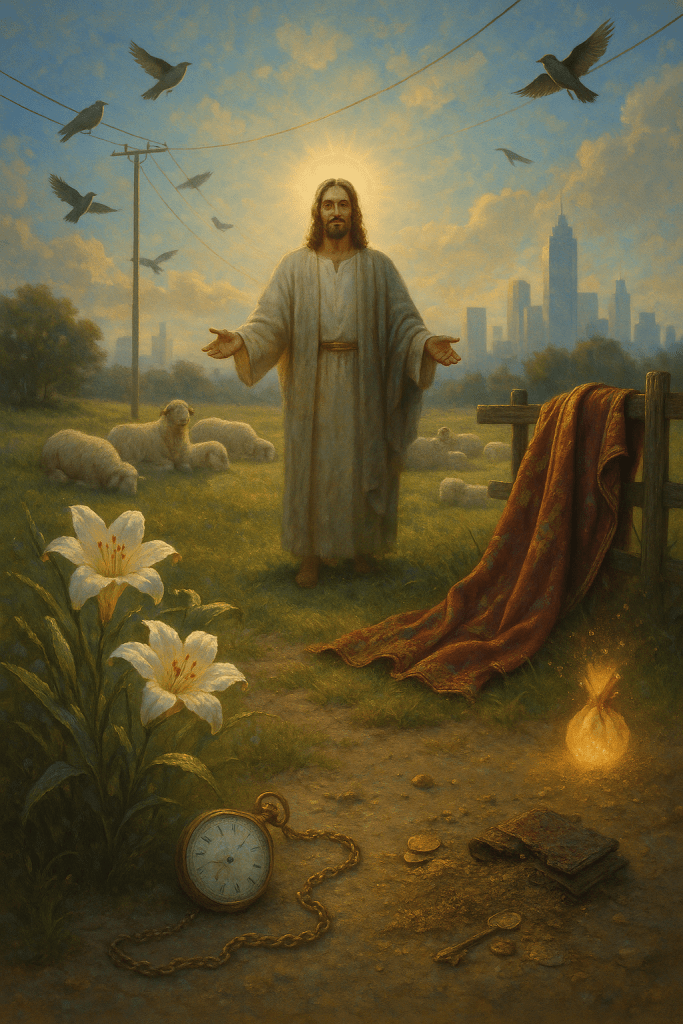
A Test of Our Hearts

Summary of my sermon, based on Luke 12:13-21. Preached at Greenhills Christian Fellowship Toronto on August 17, 2025.

This morning we turned to Luke 12:13–21. Let’s read together. “Someone in the crowd said to him, ‘Teacher, tell my brother to divide the inheritance with me.’ But he said to him, ‘Man, who made me a judge or arbitrator over you?’ And he said to them, ‘Take care, and be on your guard against all covetousness, for one’s life does not consist in the abundance of his possessions.’ And he told them a parable, saying, ‘The land of a rich man produced plentifully, and he thought to himself, “What shall I do, for I have nowhere to store my crops?” And he said, “I will do this: I will tear down my barns and build larger ones, and there I will store all my grain and my goods. And I will say to my soul, Soul, you have ample goods laid up for many years; relax, eat, drink, be merry.” But God said to him, “Fool! This night your soul is required of you, and the things you have prepared, whose will they be?” So is the one who lays up treasure for himself and is not rich toward God.’” (Luke 12:13–21, ESV).

Here we see a man come to Jesus with what seems like a fair request. He wanted Jesus to settle a family dispute over inheritance. But notice how Jesus responds. He doesn’t get into the legal details. He doesn’t play the role of arbitrator. Instead, he takes the opportunity to warn the crowd: “Take care, and be on your guard against all covetousness.”

Why? Because Jesus knows the deeper issue isn’t about inheritance—it’s about the heart. Covetousness. Greed. That subtle sin that convinces us life is found in more possessions, more wealth, more stuff. But Jesus says plainly, “One’s life does not consist in the abundance of his possessions.”

To drive this home, Jesus tells a parable. A rich man’s land produced so much that he ran out of space to store it. His solution? Tear down the barns he already had and build even bigger ones. His reasoning? “This way I can store up everything for myself and then sit back, relax, and enjoy life.” On the surface, it almost sounds wise. Isn’t this what many of us dream of? Working hard, building security, retiring comfortably, and enjoying the fruit of our labor?

But then comes the shocking twist. God says to him, “Fool! This night your soul is required of you, and the things you have prepared, whose will they be?” What a powerful reminder. All of the man’s planning, all of his storing, all of his comfort and security—it vanished in an instant. His barns stayed full, but his soul was empty.

Notice something in this parable: the man thought only of himself. In just a few short verses, he refers to himself repeatedly—“my crops, my barns, my grain, my goods, my soul.” Not once does he mention God. Not once does he think of others. His world was centered entirely on himself.

That’s why Jesus calls him a fool. Not because he planned ahead, but because he lived as though life was all about possessions, as though wealth was the ultimate treasure, as though his soul could be satisfied with bigger barns. But death exposed the truth—none of it mattered.

And Jesus closes with this piercing line: “So is the one who lays up treasure for himself and is not rich toward God.” That’s the heart of the message. Being “rich toward God.”

So what does that mean? It means recognizing God as the giver of everything we have. It means being generous, using our resources for the good of others and the glory of God. It means storing up treasures in heaven, where moth and rust cannot destroy. It means, as James reminds us, holding our plans loosely and saying, “If the Lord wills, we will live and do this or that.” (James 4:15, ESV).

And it also means remembering that Jesus is more than someone who settles disputes. The man in verse 13 wanted Jesus to fix his inheritance problem. But Jesus came for something far greater. He came to free us from sin, from greed, from the lie that life is found in what we own. He came to give us true life—life eternal.

This parable confronts us with a sobering question: are we living for bigger barns, or are we living to be rich toward God? Our possessions will one day be left behind. But Christ offers us a treasure that can never be taken away.

Called for an Attitude

Summary of my sermon, based on Luke 12:1-12. Preached at Greenhills Christian Fellowship Toronto on July 27, 2025.

Back in 2012, a lot of people were caught up in the “end-of-the-world” predictions tied to the Mayan calendar. Some even thought it might be the day of the rapture. That might sound odd because the Mayan prophecy had nothing to do with Christianity, yet some believers connected the two. Opportunists even profited from that fear. One man, Bart Centre, started a company called Eternal Earth-Bound Pets USA. His pitch was simple: if the rapture took place and Christians disappeared, their pets would need care. For $135 upfront—plus $20 per additional animal—atheist employees promised to collect your pets within 24 hours. To ensure they wouldn’t be “raptured” themselves, those workers were even asked to say something blasphemous against the Holy Spirit.

That detail points us to a serious topic: What does it mean to blaspheme the Holy Spirit? Jesus calls it “the unforgivable sin” in Luke 12:10: “And everyone who speaks a word against the Son of Man will be forgiven, but the one who blasphemes against the Holy Spirit will not be forgiven.” For centuries, Christians have wrestled with this verse. Some—like John Bunyan—feared they had committed it, though he eventually realized he hadn’t. Others, like Puritan John Child, were consumed by guilt and despair.

So what does this actually mean? And could someone commit it accidentally?

The best place to start is context. Luke 12 begins with Jesus warning about hypocrisy: “Beware of the leaven of the Pharisees, which is hypocrisy” (v.1). Hypocrisy spreads like yeast in bread—it puffs up, but it also creates holes. You might hide those gaps for a time, but Jesus says: “Nothing is covered up that will not be revealed, or hidden that will not be known” (vv.2–3). Judgment Day will expose everything—both sin and good works (1 Timothy 5:24–25). That reality is why Jesus urges His followers to fear God rather than people: “Do not fear those who kill the body, and after that have nothing more that they can do. But I will warn you whom to fear: fear him who, after he has killed, has authority to cast into hell. Yes, I tell you, fear him!” (Luke 12:4–5).

This isn’t a call to panic but to reverence. God’s power is like Niagara Falls—awesome, overwhelming, and not something to treat lightly. Yet Jesus immediately reminds us: “Are not five sparrows sold for two pennies? And not one of them is forgotten before God. Why, even the hairs of your head are all numbered. Fear not; you are of more value than many sparrows” (vv.6–7). The same God who judges sin also cares deeply for those who trust Him, enough to send His Son as our Savior.

From there, Jesus explains that we must not only fear God the Father but also acknowledge God the Son: “Everyone who acknowledges me before men, the Son of Man also will acknowledge before the angels of God, but the one who denies me before men will be denied before the angels of God” (vv.8–9). Denying Christ is hypocrisy in action—professing faith inwardly but refusing to stand for Him outwardly. Without Christ as our advocate (1 John 2:1), we have no defense on Judgment Day.

Then comes the difficult verse: “And everyone who speaks a word against the Son of Man will be forgiven, but the one who blasphemes against the Holy Spirit will not be forgiven” (v.10). Why is insulting Jesus forgivable, but blaspheming the Spirit is not?

Other Gospels help explain. In Matthew 12 and Mark 3, Jesus gives this warning after the Pharisees claim He casts out demons by Satan’s power: “He has an unclean spirit” (Mark 3:30). Calling the Spirit’s work “evil” is an extreme, deliberate rejection. But Luke’s broader context points to a more general truth: resisting the Spirit’s conviction is unforgivable because it leaves a person unwilling to repent. Jesus said in John 16:8, “When he comes, he will convict the world concerning sin and righteousness and judgment.” If someone continually rejects that conviction—attributing God’s work to Satan or dismissing it entirely—they close the door to salvation.

In other words, the “unforgivable sin” is not a careless word; it’s a hardened heart that permanently rejects the Spirit’s call to repent and trust Christ. If you’re worried you’ve committed it, that very concern is evidence you haven’t.

This passage closes with a promise: “And when they bring you before the synagogues and the rulers and the authorities, do not be anxious about how you should defend yourself or what you should say, for the Holy Spirit will teach you in that very hour what you ought to say” (Luke 12:11–12). Those who fear God rather than man will find courage, not despair.

Romans 8:38–39 sums it up: “For I am sure that neither death nor life, nor angels nor rulers, nor things present nor things to come, nor powers, nor height nor depth, nor anything else in all creation, will be able to separate us from the love of God in Christ Jesus our Lord.”

Responding to God’s Presence and Revelation

Summary of my sermon, based on Luke 11:24-36. Preached at Greenhills Christian Fellowship Toronto on Resurrection Sunday – April 20, 2025.

Despite all the miracles Jesus performed—like casting out demons—there were still some who accused him of working with Satan, or Beelzebul. Others weren’t satisfied and kept asking for more signs to prove he was the Messiah. These responses mirror what we see in our world today. Some people see Jesus as just one of many spiritual options. Others want to believe—but only on their own terms, when their personal standards of “proof” are met. But Jesus addresses both responses with clarity and boldness, especially when he talks about the “sign of Jonah.”

Jesus makes it clear that this generation’s demand for signs is evil. They weren’t seeking the truth—they were shifting the goalposts, never satisfied. So he gives them one sign and one sign only: the sign of Jonah. Just as Jonah spent three days in the belly of a great fish before being spit back out, Jesus would be buried for three days before rising again. This, he says, is the ultimate sign that he is who he claims to be.

And of course, we know what happened. Jesus was crucified, buried, and on the third day, he rose again. That’s the heart of the Gospel we celebrate on Resurrection Sunday. That’s the sign he gave—a supernatural event that no amount of skeptical reasoning can erase. And yet, the world still tries. From the earliest days, people have come up with alternative theories: maybe Jesus’ body was stolen, maybe it was a mass hallucination, maybe he never really died. But none of those explanations hold up. Roman soldiers knew how to execute. Hallucinations don’t appear to 500 people at once. And no one dies for something they know is a lie—yet that’s what happened to many of Jesus’ followers.

So what’s really going on with these objections? It’s not about evidence. It’s about the heart. People reject the resurrection not because it’s unbelievable, but because they don’t want to believe. And that’s why Jesus brings up the Queen of Sheba and the people of Nineveh. They responded to far less than what Jesus offered. The Queen of Sheba traveled great distances just to hear Solomon’s wisdom—and ended up praising Yahweh. The Ninevites repented at Jonah’s preaching, even though Jonah was reluctant and flawed. And yet Jesus, who is greater than Solomon and Jonah, stood before them—and they refused him.

So Jesus draws the line. He is the light, and his message is like a lamp. It’s not meant to be hidden—it’s meant to shine, to give light to all who will receive it. And those who open their eyes to that light will be full of it—full of truth, full of life. But those who keep their eyes shut, who refuse to believe unless every demand is met, will remain in darkness.

This is where Jesus lands the point. Be careful that the light in you isn’t actually darkness. The resurrection isn’t just a nice idea or a hopeful story—it’s the sign. The one sign we’re given. And the proper response isn’t more demands, more debate, more delay. The proper response is faith. Receive the message. Accept the light. And let it fill you.

Following the Finger of God

Summary of my sermon, based on Luke 11:13-23. Preached at Greenhills Christian Fellowship Toronto on Good Friday – April 18, 2025.

We just read the familiar story of the crucifixion of Jesus, and while it would be easy to linger there, our sermon series, Journey to Jerusalem, moves us to Luke 11:14–23. Surprisingly, the themes in this passage actually echo what we just saw at the cross. Here again, Jesus performs a miracle—casting out a demon from a mute man. It’s not the first time we’ve seen this, and by now, in Luke’s Gospel, it almost feels routine. But something has shifted. The opposition to Jesus isn’t just skeptical anymore—it’s growing hostile.

Instead of marvelling or asking honest questions, some begin accusing Jesus of being in league with demons. In Luke 11:15, they say, “He casts out demons by Beelzebul, the prince of demons.” Others aren’t as aggressive but still resist belief, saying in verse 16, “while others, to test him, kept seeking from him a sign from heaven.” Both reactions still exist today. Some accuse Jesus or Christians of being harmful or deluded. Others say they’ll believe if God just proves Himself—on their terms.

We saw this same mindset at the cross. The crowd scoffed, “If you are the Christ, save yourself!” The soldiers mocked, “If you are the King of the Jews, save yourself!” It’s a mindset that makes faith conditional: “I will believe in Jesus if He gives me what I want.” Whether it’s wealth, healing, or a specific answer to prayer, the demand is the same—“Do this, and then I’ll believe.”

But Jesus doesn’t operate on our terms. Who are we to demand a sign from God? In fact, in Luke 11:29, He says, “This generation is an evil generation. It seeks for a sign, but no sign will be given to it except the sign of Jonah.” Sign-seeking is not faith—it’s bargaining. And God doesn’t negotiate salvation. He gives it freely by grace, through faith. Ephesians 2:8–9 makes that clear: “For by grace you have been saved through faith… not a result of works.”

And that’s what this is—works-based belief. “I will believe when…” is just another way of earning your way to God. But faith doesn’t wait for proof. Faith says, “God is able… but if not…” Just like Shadrach, Meshach, and Abednego said in Daniel 3, even if God doesn’t do what we ask, we will still trust Him.

And here’s the thing—people who demand a sign often move the goalpost. Even if Jesus had stepped down from the cross, those mocking Him would have just asked for something else. Just like Pharaoh in Exodus who saw ten plagues and still hardened his heart. If your faith depends on your demands being met, you’ll never be satisfied.

On the other end, some claim Jesus isn’t the only way—they say He’s one truth among many. That’s the spirit of postmodernism: all truths are equal, and no one can claim exclusive truth. But Jesus confronts that thinking. In Luke 11:17–19, He logically dismantles the idea that He casts out demons by Satan’s power. A kingdom divided against itself cannot stand. And by that same logic, postmodernism crumbles. If everything is true, then nothing is true.

Jesus doesn’t leave room for multiple truths. He says in John 14:6, “I am the way, and the truth, and the life.” That’s not a suggestion. It’s a claim. And it’s either true or it isn’t—there’s no middle ground.

Finally, Jesus closes this section with a powerful phrase in Luke 11:20: “But if it is by the finger of God that I cast out demons, then the kingdom of God has come upon you.” The finger of God—just like in Exodus, when the magicians of Egypt saw God’s power and could no longer deny it. Jesus is stronger than any enemy. He’s not just another voice in a crowd of opinions. He is the King who conquers, the Truth who saves, and the God who calls us to believe—not on our terms, but on His.

More Than Words

Summary of my sermon, based on Luke 11:1-13. Preached at Greenhills Christian Fellowship Toronto on April 13, 2025.

It’s funny how easily we can overlook what’s right in front of us just because it’s familiar. A friend of mine who’s been living in Japan for years admitted that I, as a tourist, had seen more of his adopted home than he had. I think the same could be said for a lot of us and our own city. We miss the wonder, the beauty, the significance of things simply because we’ve seen them too often. And sometimes, that same kind of dullness happens with Scripture—especially with passages we know by heart, like the Lord’s Prayer. That’s why looking at the version in Luke 11 is so refreshing. It’s a little different than the version we’re used to from Matthew 6, and that difference wakes us up to its meaning again.

In Luke 11, Jesus is responding to a personal request from one of His disciples: “Lord, teach us to pray.” It’s not a sermon to the crowds like in Matthew; it’s a conversation with someone close to Him. That context matters. It tells us that prayer isn’t just a performance or a public discipline—it’s relational. It’s intimate. And the very first word Jesus uses shows us just how intimate prayer is supposed to be: “Father.” That one word would have shocked the disciples. The God whose name was so holy it couldn’t even be spoken aloud is being addressed like a parent? This wasn’t how people talked to God. In fact, throughout the Old Testament, God is only referred to as “Father” about fifteen times, and almost always in the collective sense—as the Father of Israel. Jesus, on the other hand, refers to God as Father around 250 times in the New Testament. And each time, it carries a sense of closeness that had never been seen before.

But just because Jesus invites us to intimacy with God doesn’t mean we lose our reverence. That’s the tension we often get wrong. I remember hearing someone open a public prayer with “Hey God,” and it struck me—even as a teenager—as disrespectful. It felt like the pendulum had swung too far in the direction of casual. Then there’s the idea of calling God “Daddy,” based on the Aramaic word “Abba.” But that term was used not just by little children but by adults as well—it wasn’t baby talk; it was just the everyday word for “father.” So yes, God is close. Yes, He is familiar. But He is still God. That’s why the next line matters so much: “Hallowed be your name.” To hallow something is to set it apart, to recognize its sacredness. We’re not making God holy by saying this; we’re acknowledging His holiness. We are worshiping.

That distinction between praise and worship is subtle but important. Praise celebrates what God has done—His works, His blessings, His victories. Worship, on the other hand, is about who He is—His character, His nature. And both have their place in prayer. Praise can prepare our hearts for worship. It helps us focus on God’s character by reflecting on how His character has shown up in our lives. When we say, “Hallowed be your name,” we’re doing just that—we’re stepping into worship, affirming God’s holiness, and aligning our hearts with who He is.

Then we move to “Your kingdom come.” This is where our longing for God’s rule comes into play. It’s an act of trust—a declaration that we believe in His justice, His order, and His plan. We know His kingdom is already here in part, and we’re also waiting for the day when it will come in full. This line holds both present faith and future hope. It reminds us that we’re living in the “already and not yet” of God’s reign. And it realigns us—it pulls our eyes off our own agendas and toward God’s bigger picture.

“Give us each day our daily bread.” This is about provision, yes, but it’s also about dependence. Every day we come to God, acknowledging that He is the one who sustains us. It echoes Philippians 4:19, which promises that God will supply all our needs. Not our wants. Not our fantasies. But what we need. And the fact that Jesus tells us to ask for daily bread, not a lifetime supply, is a reminder that our relationship with God is meant to be ongoing, constant, daily.

“Forgive us our sins, for we ourselves forgive everyone who is indebted to us.” This part shifts the focus to our relationships—with God and with others. Asking for forgiveness is one thing—but Jesus links it directly to how we treat other people. If we truly understand the grace we’ve been shown, it will overflow in grace toward others. Like in the parable in Matthew 18, the one who’s been forgiven much should be the first to extend mercy. It’s a gut-check for us. Are we holding grudges while asking God for grace?

And finally, “Lead us not into temptation.” This isn’t just a plea to avoid difficulty. It’s a recognition of our weakness. It’s an honest admission that we need God’s help to stay on the path. 1 Corinthians 10:13 assures us that God won’t let us be tempted beyond what we can bear—but we still need to ask for that strength. We still need to be humble enough to say, “God, I can’t do this on my own.”

So this prayer that might feel overly familiar suddenly becomes a rich framework for how we relate to God. It’s not just a script—it’s an outline. A way to approach God with the right heart: as children who are both loved and in awe. Who trust Him with our daily needs, with our future, and with our hearts. Who come to Him intimately, but never casually. Who praise Him, worship Him, and want His name to be made holy—not just in our words, but in our lives.