

The Importance of Praise and Thanksgiving

Summary of my sermon, based on Luke 17:11-19. Preached at Greenhills Christian Fellowship Toronto on Sunday, 28 June 2026.

The Importance of Praise and Thanksgiving
As we continue our sermon series on Jesus’ journey to Jerusalem, it is important to remember that this path is not merely a physical trek from Galilee to the cross; it is a journey of fate. Jesus is moving toward his crucifixion, resurrection, and ascension, all while preparing his disciples for the time when he would be physically absent from them.

Along this journey, Jesus passes through the border of Samaria and Galilee. This is significant because Jews at that time generally avoided Samaria, often taking circuitous routes along the Jordan River to bypass the region entirely. The tension was both racial and religious; Samaritans were seen as “half-Jews” who practiced religious syncretism, worshipping Yahweh alongside foreign idols. Even those who maintained a semblance of the Jewish faith were viewed with suspicion due to theological differences, such as their focus on Mount Gerizim and adherence only to the Pentateuch. Yet, Jesus chooses to go directly through this marginalized territory.

Radical Compassion on the Margins
As he enters a village, Jesus is met by ten lepers standing at a distance. Leprosy in the ancient world was a devastating, contagious condition that resulted in permanent social and spiritual isolation. According to the laws in Leviticus 13, those afflicted were required to live outside the camp and cry out, “Unclean, unclean.” Their isolation was absolute; they were quite literally on the margins of society.

The presence of ten lepers in one small village suggests a pandemic-level crisis for that community. Yet, Jesus chooses to enter this very place. This demonstrates his radical compassion for those in need—a compassion that his followers are called to mirror. As 1 John 3:17–18 challenges us: “But if anyone has the world’s goods and sees his brother in need, yet closes his heart against him, how does God’s love abide in him? Little children, let us not love in word or talk but in deed and in truth.”

We are called to be involved in the ministry of mercy. While not all are called to be missionaries in the slums of Manila or India, all believers are called to cultivate an intimate understanding of the needs of others. This goes beyond general prayer; it involves actively learning about the needs of specific missionaries and agencies, and personally participating in the work of God’s kingdom.

The Miracle and the Response
When the ten lepers cry out, “Jesus, Master, have mercy on us,” Jesus notices them and gives an seemingly anticlimactic command: “Go and show yourselves to the priests.” In Leviticus 14, this process was the prescribed way for someone healed of leprosy to be declared clean and restored to society. Jesus was effectively telling them, “You are going to be healed.”

Sure enough, as they went, they were cleansed. Yet, the main point of this passage appears in verses 15–18. Only one, a Samaritan, turned back, praising God with a loud voice and falling at Jesus’ feet to give thanks. Jesus responds, “Were not ten cleansed? Where are the nine? Was no one found to return and give praise to God except this foreigner?”

The Problem of Ingratitude
The nine who did not return were not necessarily ungrateful in their hearts, but they failed to express that gratitude. This failure highlights two major issues in the human heart. First, it betrays a tendency to take blessings for granted, often fueled by the modern obsession with comparison and the “greener grass” of social media. We live in a land of unprecedented abundance, yet many remain trapped in a cycle of melancholy and discontent.

Second, the lack of gratitude betrays a misunderstanding of the source of our blessings. It is easy to attribute our provisions to our own labor or circumstances rather than to God. Romans 1:21 provides a sobering perspective on this: “For although they knew God, they did not honor him as God or give thanks to him, but they became futile in their thinking, and their foolish hearts were darkened.” Failing to give thanks is equated with failing to honor God as God.

The Deeper Blessing of Salvation
All ten lepers were physically healed, but to the one who returned, Jesus said, “Rise and go your way; your faith has made you well.” While God provides general blessings to all, the deeper blessing of salvation is found only in Christ.

Praise and thanksgiving are matters of faith. We praise God not just for the material provisions of this life, but because we are people saved by grace. As Colossians 3:16–17 instructs, we let the word of Christ dwell in us richly, “singing psalms and hymns and spiritual songs, with thankfulness in your hearts to God.” Everything we do in word or deed should be done in the name of the Lord Jesus, giving thanks to God the Father through him.

United in the Gospel

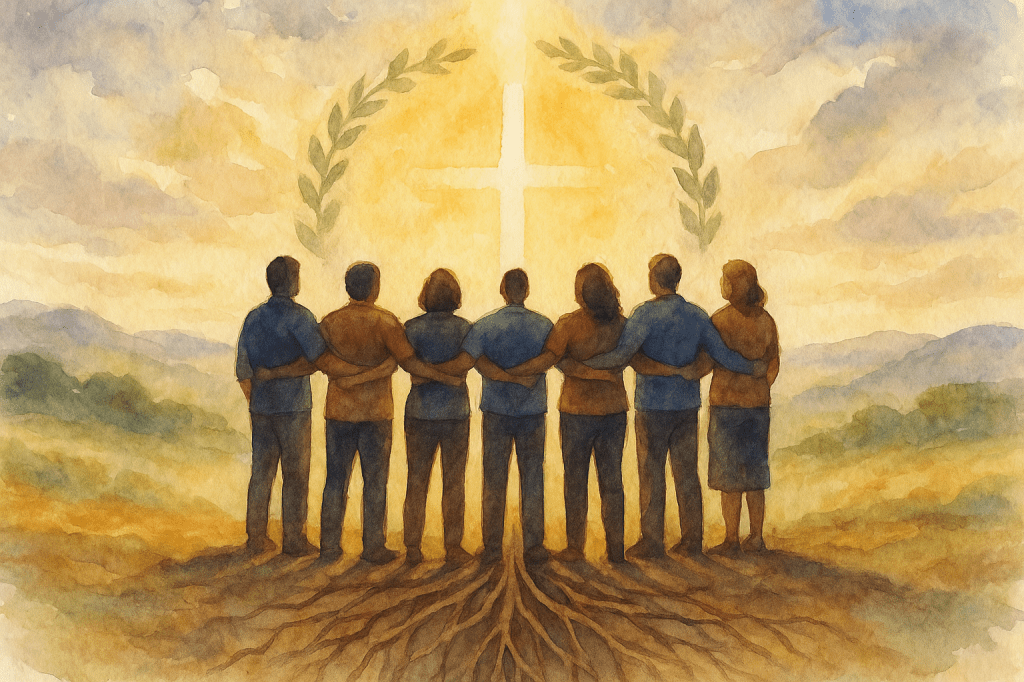
Summary of my sermon, based on Philippians 1:27-2:4. Preached at Greenhills Christian Fellowship Toronto on October 12, 2025.

Our text is Philippians 1:27–2:4. Hear Paul’s charge (ESV): “Only let your manner of life be worthy of the gospel of Christ, so that whether I come and see you or am absent, I may hear of you that you are standing firm in one spirit, with one mind striving side by side for the faith of the gospel, and not frightened in anything by your opponents… So if there is any encouragement in Christ, any comfort from love, any participation in the Spirit, any affection and sympathy, complete my joy by being of the same mind, having the same love, being in full accord and of one mind… Do nothing from selfish ambition or conceit, but in humility count others more significant than yourselves. Let each of you look not only to his own interests, but also to the interests of others.”

Unity is fragile. I remember where I was on September 11, 2001—how a moment galvanized nations. Yet the legacy of the “war on terror” is complicated. Mission creep set in: Afghanistan led to Iraq, “freedom fries” replaced French fries in some restaurants, and “mission accomplished” was declared far too soon. Two decades later, Afghanistan returned to Taliban control. That’s what mission creep does—when objectives drift, unity fractures. And this isn’t just geopolitics; it happens to churches. When our mission creeps away from the gospel, unity crumbles.

Paul gives us the basis of gospel unity: “Only let your manner of life be worthy of the gospel of Christ.” The phrase translated “manner of life” reflects a citizenship idea (politeuesthe)—live as citizens. He’s cueing what he’ll say later: “But our citizenship is in heaven” (Phil. 3:20). Read 1:27 like this: “Let your conduct as heavenly citizens be worthy of the gospel.” Why this framing?

First, citizenship speaks to duty. In earthly civic life we obey laws, pay taxes, serve on juries, vote, stay informed. In the same way, our heavenly citizenship carries responsibilities, not just benefits. Today, citizenship talk often centers on benefits. I’ve seen it up close: many reacquire Philippine citizenship primarily for property rights. Benefits matter, but if that is all citizenship means, something vital is lost. Many Christians think of heavenly citizenship the same way—deliverance from hell, mansions in glory, and for some, invented “benefits” like guaranteed wealth and health. But Scripture calls us to responsibilities too: “Walk in a manner worthy of the calling to which you have been called” (Eph. 4:1). Benefits are real and glorious; duty is real, too.

Second, citizenship warns against dual allegiances. Roman citizenship in Paul’s day was costly and coveted (see Acts 22:27–28), and it could easily eclipse heavenly priorities. Paul redirects the Philippians: live according to the gospel, not the shifting demands of society. We see what happens when churches let society set the agenda. I think of a nearby congregation that once had a self-professed atheist minister and now organizes around values untethered from the gospel. It looks more like a social club—nice people, a knitting circle—but with little affection for Jesus. What’s the point of meeting weekly if not to know, love, and obey Christ? When earthly agendas dominate, gospel unity dissolves.

What happens when we are united in the gospel? Paul says it plainly: “…not frightened in anything by your opponents” (Phil. 1:28). Gospel unity produces courage because it provokes opposition. The very existence of a holy, united church is “a clear sign… of their destruction, but of your salvation, and that from God” (v. 28). That’s hard truth. The gospel divides. As John 3:36 says, “Whoever believes in the Son has eternal life; whoever does not obey the Son shall not see life, but the wrath of God remains on him.” No wonder the world pushes back.

Yet we need not fear. “Fear not, for I am with you” (Isa. 41:10). “God gave us a spirit not of fear but of power and love and self-control” (2 Tim. 1:7). And Paul goes further: suffering for Christ is not an accident; it is a gift. “For it has been granted to you that for the sake of Christ you should not only believe in him but also suffer for his sake” (Phil. 1:29). How can suffering be a gift? Because it brings reward: “Blessed is the man who remains steadfast under trial… he will receive the crown of life” (Jas. 1:12). Because it re-weights our hearts: “This light momentary affliction is preparing for us an eternal weight of glory beyond all comparison” (2 Cor. 4:17). And because it shapes us now: “We rejoice in our sufferings, knowing that suffering produces endurance, and endurance produces character, and character produces hope… because God’s love has been poured into our hearts through the Holy Spirit” (Rom. 5:3–5).

We don’t have to look far to see a world groaning—earthquakes, storms, disease, lonely deaths. I recently watched a story from a Japanese cleaning company that specializes in “kodokushi,” lonely deaths where people go undiscovered for weeks. The owner, also a Buddhist monk, performed rites and told a grieving sister he hoped her brother would enter Nirvana. She replied, “I hope he is able to enter heaven.” That aching uncertainty is everywhere apart from Christ. The world is full of suffering; we need the living hope of the gospel, and we need each other—united—to endure and witness.

How then do we maintain gospel unity? Paul repeats himself for emphasis: “Complete my joy by being of the same mind, having the same love, being in full accord and of one mind” (Phil. 2:2). He knows division can destroy a church. He pleads elsewhere, “that there be no divisions among you… for it has been reported to me… that there is quarreling among you” (1 Cor. 1:10–11). Unity is not optional; it is essential to faithfulness and mission.

And he tells us how, with simple, searching commands: “Do nothing from selfish ambition or conceit, but in humility count others more significant than yourselves. Let each of you look not only to his own interests, but also to the interests of others” (Phil. 2:3–4). That’s the way. Lay down selfish ambition. Refuse conceit. Cultivate humility. Consider others as more significant. Look to their interests. If each of us looks out for the others, all needs are met and unity is preserved.

It also happens to be Thanksgiving. Gratitude steadies unity. “Therefore let us be grateful for receiving a kingdom that cannot be shaken, and thus let us offer to God acceptable worship with reverence and awe” (Heb. 12:28–29). We have received an unshakable kingdom. So, let’s live as heavenly citizens worthy of the gospel, stand firm in one Spirit, strive side by side, refuse fear, embrace the gift of suffering, and, in humility, look to the interests of one another—with reverence, awe, and thanksgiving.